Friday, December 09, 2011

Interview with Hugh Gross, director of 'After the Wizard'

Earlier this week, I got the opportunity to interview Hugh Gross, the director and writer of the indie film 'After the Wizard', which premiered in Kingman, Kansas on July 2nd. 'After the Wizard' is a modern sequel to The Wonderful Wizard of Oz and tells the story of a young Kansas girl named Elizabeth, played by Jordan Van Vranken.

Could you tell us a little bit about how the movie came about, and what the premise of the movie is?

I had a vision some years ago about the Scarecrow and the Tin Woodman coming to Kansas to find Dorothy. It was very sketchy and I didn't do much about it until six or seven years ago when I wrote “After The Wizard” as a children’s book. I’m a published novelist and playwright and I did have an agent, but we were unable to interest a publisher. In 2009, while a play I wrote called “Stated Income” had a production at a small theater in Hollywood, I started thinking about other projects I could adapt for the theater. I tried to adapt an unpublished novel I’d written about a professional poker player, which didn't work well on the stage, and I tried “After The Wizard,” which did. However, the challenges involved with a 12-year-old lead, dog, balloon launch and tornado were overwhelming. I had previously worked in video production and post-production so I was somewhat aware of recent advances in camera technology and editing software. It made much more sense to proceed as a film than as a stage play. I adapted the work as a screenplay and was able to secure financing.


Did you take any inspiration from the 14 Oz books by L. Frank Baum, or did you mostly rely on the 1939 movie and your own ideas?

Everything in “After The Wizard” is drawn from the original books by L. Frank Baum, which are in the public domain, or original to our movie. We were very conscious on all fronts – story, dialogue, design, music, etc. – not even to wink at the 1939 movie or any of the other later adapted works such as “The Wiz” and “Wicked” which are not in the public domain and to which we do not have rights. That is why, for example, you will not find ruby slippers or even a spoken reference to ruby slippers in “After The Wizard.”

Last we heard, distribution was being worked on by the production. What are the current distribution plans or hopes? Any idea when we'll be able to see the movie?

Producer’s rep Ronna Wallace of Eastgate Films just signed to represent the film. Ronna has placed many significant independent films. This is a great development for “After The Wizard” and I’m very optimistic. With just a little luck the movie should be available for viewing in 2012.

How was the general reaction from the audience at the premiere screenings in Kingman, Kansas over the summer?

The response was overwhelmingly positive. We had more than two hundred volunteers from Kingman who participated as extras or behind the scenes in the movie so perhaps it wasn’t an entirely objective audience. Still, we had coverage from Wichita network affiliates of CBS, NBC and ABC. An article that appeared in the Hutchinson Times (we also filmed in Hutchinson) was picked up by Associated Press and ran as far away as The India Times. As you know there is an incredibly deep affection for the original story and characters. In addition, “After The Wizard” is a true family film, which seems to come as a relief and broadens its appeal. Audience members particularly seem to enjoy a sense of having the Scarecrow and the Tin Woodman visit America.

How was your overall experience working on the film? Did the cast and crew get a long when the cameras weren't rolling?

Working on “After The Wizard” was immensely satisfying. There were deep friendships made through production and post. At the same time, and speaking honestly, I don’t think there’s ever been an independent film in the history of the world where everyone got along at all times. We filmed in six states. Our schedule was brutal. Definitely, there were some tensions among the crew. Without question it was a very talented group that came together to make the movie and I trust now that we’re done everyone will take great satisfaction in what we've been able to accomplish.


Why do you think Oz fans should check out this movie in particular?

“After The Wizard” is not only a take-off and/or adaptation involving the original characters, it’s about what the original story and characters mean to those who love them. The movie is therefore a little unusual even in the Oz-inspired universe, heartwarming and hopefully inspiring to all.

Thanks to Hugh for doing the interview! Looking forward to seeing this movie. Let us know what you think of the movie in the comments below!


Thursday, December 08, 2011

My Early Years in Oz

And we all wonder, "What happened?"
I was introduced to Oz at a young age when I saw the MGM musical The Wizard of Oz on television. To this day, I have a love of fiction, be it literature or film, that's either fantasy, grittily realistic, surreal, or just plain weird. So it was no wonder that Oz caught my eye.

To be sure, I can't honestly remember too much about the film after I first saw it. The image that stuck with me the most was Dorothy and her friends venturing into the Witch's forest. Not Munchkinland, not the Emerald City, not the poppy field, not the yellow brick road, not even the Witch herself or the Flying Monkeys. It was a little girl, three strange looking companions, and a dog going somewhere dangerous and spooky. (I also love stories that scare the heck out of me with something besides gore.)

We lived in a little house that was across the street from an elementary school. We had a big back yard with two big trees and a garage my dad kept his stuff in, aside from our lawnmower, bicycles, and the garden hose. (It was more like an oversized shed with a dirt floor.) Even though our parents objected, we'd often look through dad's boxes. They contained many, many books and comics. I'd learned to read during the first grade, and over the summer developed it independently. And two things that really helped were a few things I'd fished out of the garage.

I wasn't sure what the story in these books was, but I could see they had the word OZ in them in big letters. Looking at the title a bit harder, I could make it out better: Return to Oz. There was a coloring book and a comic book. Later, I found a copy of Return to Oz: Dorothy in the Ornament Rooms in the back of our van. These were lots of fun to look through.

At some point, our school showed us Dorothy in the Land of Oz and MGM's The Wizard of Oz. I looked in the school library to see if there was a Wizard of Oz book. It was years before I realized which edition I was holding. It was a long book with lots of odd-looking pictures of little people all in black and white. The front cover showed the Scarecrow and Tin Woodman carrying Dorothy through the Poppy Field, while the Cowardly Lion wiped a tear from his eye with his tail on the back. I know now that it was a "white edition," with illustrations by Denslow with a lot of art adaptation work done by Dick Martin.

One day, my grandfather had my dad and my brother and I over as he was moving and he was turning some more of dad's things over to him. I recall one book as it was packed up: a Grosset and Dunlap Illustrated Junior Library edition of The Wizard of Oz. I looked at it all the way home. Sometime later, I fished it out of the garage. After looking at Evelyn Copleman's lovely MGM-influenced art, I eventually put it away.

One day, we were at the library and my dad asked if there was a video I'd like to check out. Well, I hadn't seen the MGM film for a year or so, so I asked for The Wizard of Oz. When we told the librarian, we were presented with a videocassette in a plain black clamshell. I was so excited and clutched it tightly until we got home. Then, I opened it eagerly.

Imagine my dismay when my brother read what was written on the videocassette: Installing Kitchen Cupboards And Cabinets. The next week, we returned it and informed the librarian of the mistake. We placed a hold on the tape and it eventually came in. There was no mistaking this one: there was Margaret Hamilton, all in her green wickedness, with a flying monkey and her crystal ball.

We were going to watch it one Saturday afternoon, but we got to Munchkinland and suddenly, the VCR broke. After we established it'd be awhile before we could fix or replace it, I was a little disappointed. Going to my room, I looked through my books and found dad's copy of the book. I opened the book and went to the first page. I'd already read The House at Pooh Corner, so I felt sure I could do this.

"Dorothy lived in the midst of the great Kansas praries..."

I recall it took me awhile to get through the book. But I finished it during the Thanksgiving drive to our grandparent's house in the country. Shortly after, my dad spent a dollar at Wal-Mart for Aerie paperback editions of Ozma of Oz and The Lost Princess of Oz. I ate up Ozma, but I didn't read Lost Princess for a long time. My mom was impressed as she read Ozma afterward and placed it at a 7th grade reading level. (I'm not sure if that's accurate...)

Starting with third grade, my mother decided she'd homeschool me along with my brothers. (She felt my oldest brother wasn't being educated properly.) One day, she took us to the library during the afternoon, and I wanted to see if the library had any other Oz books. Mom found me the second Oz book, which was a Del Rey copy of The Land of Oz, and a copy of Who's Who in Oz. (Yes, it was the late 1980s reprint.)

I recall reading The Land of Oz with a flashlight at night, and skipping the chapter "The Tin Woodman Picks A Rose" because it didn't sound interesting enough. I later discovered what a great mistake that was... (Thanks, Flo Gibson!)

My Oz collection wasn't big or notable. It was supplemented one Christmas with a big box of Aerie paperbacks: The Land of Oz, Dorothy and the Wizard in Oz, The Road to Oz, The Emerald City of Oz, and Rinkitink in Oz. (To date, I have been unable to discover if any other books were issued in these editions, aside from Wizard.) I read these, supplemented by Del Rey editions of The Patchwork Girl of Oz (which I took with me to my grandparents where I stayed for a few days in the summer one year), The Scarecrow of Oz, and The Tin Woodman of Oz, thanks to the library. Later, I got library editions of Mister Tinker in Oz and Dorothy and Old King Crow from library book sales, as well as Return to Oz: Dorothy Returns to Oz.

My dad turned a copy of the Classics Illustrated Junior Wizard of Oz over to my collection, and I collected a lot clippings and a read along book and tape by Disney of the first Oz story.

I drew lots of Oz pictures, even in my Aerie editions, since they didn't have interior illustrations. One Sunday afternoon, my dad and I took a huge piece of butcher paper and drew a scene on the yellow brick road. There was a big gap in the road, just like in the book. I vividly remember my dad's Cowardly Lion, chewing his claws nervously as the group pondered how they'd get across. The Emerald City was in the background. (Don't ask.) The Wicked Witch was flying on her broomstick, the Wizard was in his balloon, and Glinda was ... also in a balloon. (It was more fun than a bubble.)

My dad later found a paperback Ozma of Oz and gave it to me. It was by either Rand McNally or Scholastic, and was similar to the white editions. I remember being struck at how different Dorothy looked. When I'd seen her on the cover of a Books of Wonder Ozma at the library before, I'd thought the girl on the front was Ozma.

I got a pen pal who also read the Oz books, and one day, while looking for later Oz books at the library, I met an older girl who also read them. I wish I knew who these people were now. These were the only fellow Oz fans I knew of.

My dad also turned up Eric Shanower's The Secret Island of Oz and The Ice King of Oz at the library, and I eagerly read these and The Blue Witch of Oz, which I found later. I also recall looking for pictures in the library's copy of The Making of the Wizard of Oz.

I made Oz clothespin dolls and one year, my mom made my birthday cake with pale green icing with a castle and a road leading to it outlined in chocolate chips. (It didn't taste that good, but I didn't mind too much.) We visited Kansas once, and I found some Oz-themed postcards that I was allowed to get. Every time I saw something that was Oz, I was thrilled.

I would love to say my love for Oz continued throughout my childhood and I found the rest of the Baum books and eagerly read them and the others in the Famous Forty, discovered the International Wizard of Oz Club and joined at a young age. And I'd love to say that Oz instilled in me a great love of literature and I read lots of books, not just Oz.

Sadly, none of that would be true. A lot of Oz fans say they leave Oz behind when they got older and returned to it later. You could say that happened, but the truth was, my Oz love was cut short before I was 11. And not by my choice, though I did consent, believing a certain person knew better than me at the time.

At age 40, my mother became very religious. And one day, I guess she felt "convicted" about my love of Oz, and told me she didn't want me to have anything more to do with witchcraft, which she felt was the main theme of Oz. Like I said, I thought she knew best, and so my entire Oz collection went into the garbage. (My dad wasn't thrilled about it.)

What mom failed to notice is that my interest in reading waned after Oz was disposed of. The only book I can really recall reading thoroughly and enjoying during those years was The Adventures of Tom Sawyer. I felt like I was a lazy reader. Probably the more likely reason was that anything that really, really interested me, I was forbidden to enjoy. I checked out an audiobook of The Hobbit from the library and, when attempting a second listen-through, I was told to shut it off by my mother because she heard something about a necromancer. When I attempted readings of Alice in Wonderland, I was told I shouldn't spend too much time on nonsense.

I think the best example of the results of this is when I was told to read Shakespeare and literally fell asleep on the first page.

I firmly believe that children should be allowed to read books they enjoy. As they do this, their interests grow, and they try reading more things. The more varied their reading, the bigger a vocabulary they will have, and they will notice how to write properly as they read. Instilling the thought that some literature is dangerous at such an impressionable age is much more dangerous than a book could ever be.

By some lucky happenstance, I had second thoughts about Oz years later when I saw the MGM Wizard of Oz at a youth center I visited regularly. This wasn't a story about witchcraft. It was a story about friendship and love for your family. Good versus evil! What was so wrong about Oz after all? Nothing I could see.

Thanks to the library (libraries are awesome), I sneaked in Oz books. Eventually, mom found out. She appeared okay with it at first, but there were times when she would lecture and even yell at me about it. One time, she even attempted to pray it away. But I'd made up my mind. The enjoyment I was getting from Oz was much better than those years of lazy reading where I found little to interest me except sneakily read comic books from dad's collection. (Yes, she disapproved of these, too.)

I found out a lot more about Oz thanks to the internet and read some of Baum's non-Oz work by downloading it online at the library on a floppy disk and reading it at home on our Windows 3.1 computer. ("In 2000?" We were really late-bloomers in the computer age.) I started collecting Oz frequently and joined the International Wizard of Oz Club after I began working a job in 2004, right after I'd passed the GED test and turned 18. After I turned 20, my sister and I moved out into our own apartment partly because mom and dad were moving, too, and partly because we just didn't want to live with mom anymore. (They'd actually lost our childhood home by defaulting on our mortage, which they'd gotten because mom wanted new windows.)

Many items from my original Oz collection have since been replaced, either by better editions, similar editions, or the same editions. Of course, my Oz collection now overflows from a bookshelf. I have three big plastic tubs full of The Baum Bugle, Oziana, and various Oz comics and other publications. I have another tub I've devoted to more Oz books. Hopefully I can move to a larger home in the near future where I can let my Oz collection be displayed more properly.

And that's my story.

Monday, December 05, 2011

Sweet Wishes and Pegasus

Sweet Wishes from Oz, by Marin Elizabeth Xiques - As might be expected from the title, the book is a bit saccharine, but still a fun read. It involves Wintergreen, a candy-making elf who works at the North Pole, opening a candy store in the Emerald City in order to gain inspiration. Meanwhile, a boy named Andy tries to perform an elf's work at Santa Claus's workshop. A major plot point involves Andy's parents, who, after an unfortunate accident involving bags of chocolate coins, no longer enjoy the holidays and instead just go through the motions in order to impress the neighbors. The reference to people who have traded in the holiday spirit for commercialism and making a show is obvious, but I think the story gets a little un-Ozzy in order to make its point. I can't really buy that Oz has camcorders, especially when it apparently still doesn't have television. Oh, well.

Pegasus in Oz, by Annie Brzozowski - The author was quite young when she wrote this, and as it doesn't appear that Chris Dulabone generally does all that much in the way of editing, it shows. The thing is, the plot is actually pretty good, and there are a lot of ideas that have potential. It's just that they're never fully developed, and the dialogue is rather stilted. Mind you, I commend anyone who can get a book they wrote as a kid published, even if it's by a small non-profit organization. I feel, however, that it could benefit from a good rewrite. The story involves several Ozites journeying to Ev to save the last remaining pegasus from a ravenous cyclops, and there are some interesting twists at the end.

Sunday, December 04, 2011

Santa Claus: Baum vs. Everyone Else

Santa Claus has many forms all over the world, but the most popular version is how he's evolved in the United States. Our version is an amalgamation of many worldwide traditions. The popular image of Santa Claus was established by the end of the 19th Century, mainly by Clement C. Moore's famous poem, "The Night Before Christmas" and the the drawings of Thomas Nast.

America's Santa Claus lives in the North Pole where he spends the year making toys for good children, assisted by Elves (normally depicted as brownie-type beings) and, sometimes, Mrs. Claus. Every year on Christmas Eve, Santa visits the homes of children to deliver gifts. Some maintain that Santa keeps track of which children have been good and which ones have not, these traditions being that only good children get toys while bad children get coal, switches for their parents to spank them with, or nothing. Santa makes his visits by night, carried by eight reindeer (or nine, for those who add Rudolph) on an airborne sleigh.

Santa Claus normally wears red and is a chubby fellow (some depict him as stocky built, some make him obese), and makes his entrance in people's homes by descending through chimneys.

It seems that one Lyman Frank Baum didn't go for this. Baum never had that Santa in his fantasies. The first time Baum wrote about Santa Claus was in the story "Little Bun Rabbit," the last entry in Mother Goose in Prose, his first published children's book.

I described the story in full on this blog two years ago. In it, no mention is made of Santa neglecting naughty children. Santa lives in a castle on a hill with Mother Hubbard, his only assistant. As the rabbit in the story says he can run home from Santa's workshop, it appears Santa lives somewhere in America. In fact, only ground travel is implied.

Later, Baum gave Santa Claus a complete overhaul in The Life and Adventures of Santa Claus, quite possibly one of the oddest fantasies he ever penned. Most of his fantasies were linear stories, while Santa Claus is a history with many sections told in detail, which is unusual for a biography.

I've blogged about the book many times in the past, but I'll sum it up here. The book features Immortal beings, one of whom is Ak, the Master Woodsman of the World, who finds an abandoned baby on the outskirts of the Forest of Burzee. The child is raised by a wood-nymph and is named Claus, and later, he is taken by Ak to see the sufferings of his fellow humans. Feeling compassion for children, Claus determines to bring joy to their lives while he can, becoming a friend to all the children he meets.

Claus goes to live in Laughing Valley, where the Immortals build him a home. He visits children until winter, when the weather forces him to stay home. He makes his first toy, a wooden image of a cat and soon realizes that children like these to play with and begins making many more to give away.

One winter night, two reindeer offer to help Claus deliver toys by pulling a sledge he quickly fashions. It is at this time he begins his nocturnal visits and going down chimneys and leaving toys in stockings to save time. He is allowed to use ten reindeer to make an annual visit to children, assisted in making toys by ryls and knooks, fairies of nature that Baum created. For his visits, Claus is called a saint, which, over time, turned into "Santa Claus."

One little bit flies in the face of an established Santa Claus tradition:
...when a child was naughty or disobedient, its mother would say:

"You must pray to the good Santa Claus for forgiveness. He does not like naughty children, and, unless you repent, he will bring you no more pretty toys."

But Santa Claus himself would not have approved this speech. He brought toys to the children because they were little and helpless, and because he loved them. He knew that the best of children were sometimes naughty, and that the naughty ones were often good. It is the way with children, the world over, and he would not have changed their natures had he possessed the power to do so.
Baum himself did not approve of punishing children severely, believing that kindness was a more powerful alternative. One of Baum's sons reported that his mother had made his father spank him as a punishment, but Baum was troubled at this and later apologized to his son and vowed never to spank any of the boys again, a vow he kept. Thus, Baum's dismissal of the rule that "naughty children don't get toys" makes sense for his outlook on life.

Later, when Santa Claus is about to die, the Immortals quickly meet and vote to extend his life indefinitely by giving him the Mantle of Immortality. The biography ends with an explanation of Santa Claus' deputies among the Immortals and even parents.

Surprisingly, The Life and Adventures of Santa Claus has proved popular, especially in adaptation. (Having uploaded clips from the most prominent adaptations to YouTube, I've noted they have received many fond comments.) However, Baum's Santa Claus—which dismissed Mrs. Claus, Elves, the North Pole, and the rule of only eight reindeer—has yet to become the more popular version. Perhaps the appeal of the story is how simply novel it is to have a Santa Claus that still delivers toys in a reindeer-pulled sleigh on Christmas but yet shares no connection to any other version.


For me, I simply love that Baum gave Claus a background. Some criticize his Santa for having no defining character traits, but that's to be expected given that he's raised in Burzee, which is more or less a fantasy Garden of Eden. He had no evil influences in his life so that when he did come across them, he could resist them easily. It actually makes sense for his character.

Anyway, if you're an Oz fan, Laughing Valley is right beyond the Deadly Desert. In fact, Baum's Santa Claus visits the Emerald City in The Road to Oz with some ryls and knooks. So we know Baum's Santa Claus has to be real. Are we going to say Ozma isn't real either?
Santa Claus in Oz

Thursday, December 01, 2011

Congratulations to Mike Conway!

Congratulations to Mike Conway, who won NaNoWriMo (National Novel Writing Month) with his novel Passion Fire of Oz. And yes, he intends to publish it.

Mike is one of the writers here at the Royal Blog of Oz and has narrated most of our story podcasts. He is also working on Heroes of Oz, his own Oz-based RPG system.

The Royal Podcast of Oz: Dorothy's Christmas Tree

Mike Conway, Zach Allen, Doug Wall, Miriam Goldman, and Peter Heimsoth perform W.W. Denslow's "Dorothy's Christmas Tree" from "Denslow's Scarecrow and Tinman."

As always, you can listen at the podcast site or use the player below.


Podcast Powered By Podbean
   

Wednesday, November 30, 2011

Aunt Jane's Nieces Collection Update!

So, how's that Edith Van Dyne collection coming? Ummm...

Nicely.

Up above are the first four books in the Aunt Jane's Nieces series. The first book and Abroad are Reilly & Lee editions. (And for those who don't know, Reilly & Britton changed their name to Reilly & Lee in 1919, meaning these are later editions.) Abroad has the standard features that the earlier ones did, the frontispiece matched the story and the cover still has the pictoral design. I'm completely satisfied with it.

Aunt Jane's Nieces, however, is one of the late Reilly & Lee editions. The pictoral cover design has been dropped, and instead of this frontispiece...
 ...this one appears.
Which doesn't match the story at all. It's actually from Aunt Jane's Nieces on the Ranch. And is it just me, or do those two guys back there look like they're about to have a passionate moment? At the last Winkie auction, while displaying an Aunt Jane's Nieces book, auctioneer Bill Thompson pointed out the simple cover design and incorrect frontispiece, explaining that in the series' later years, the publisher wasn't so particular. (See? You can learn so much at Winkies, even at the auction!) So, a frontispiece that didn't match the text is a common feature in late edition AJN books. In fact, I think other publishers wound up doing it with other series books.

Back to looking for one that will match the rest. (I consider my dustjacket Red Cross 1915 a very lucky find.) I was informed the first edition had six illustrations, including the frontispiece. I'd LOVE to find one of these, but it might be out of my price range (and where I've been looking, difficult to find), so I'll settle for one with the pictoral cover and original frontispiece.

Oh, and I'll have to find a 1918 or after Red Cross as well... And no, I haven't forgotten the Mary Louise books, but it's not like I can buy all the Oz stuff I want when I want. Anyway, if I could, I'd deplete my wishlist too fast and have nothing to look for.

The Wonderland of Oz

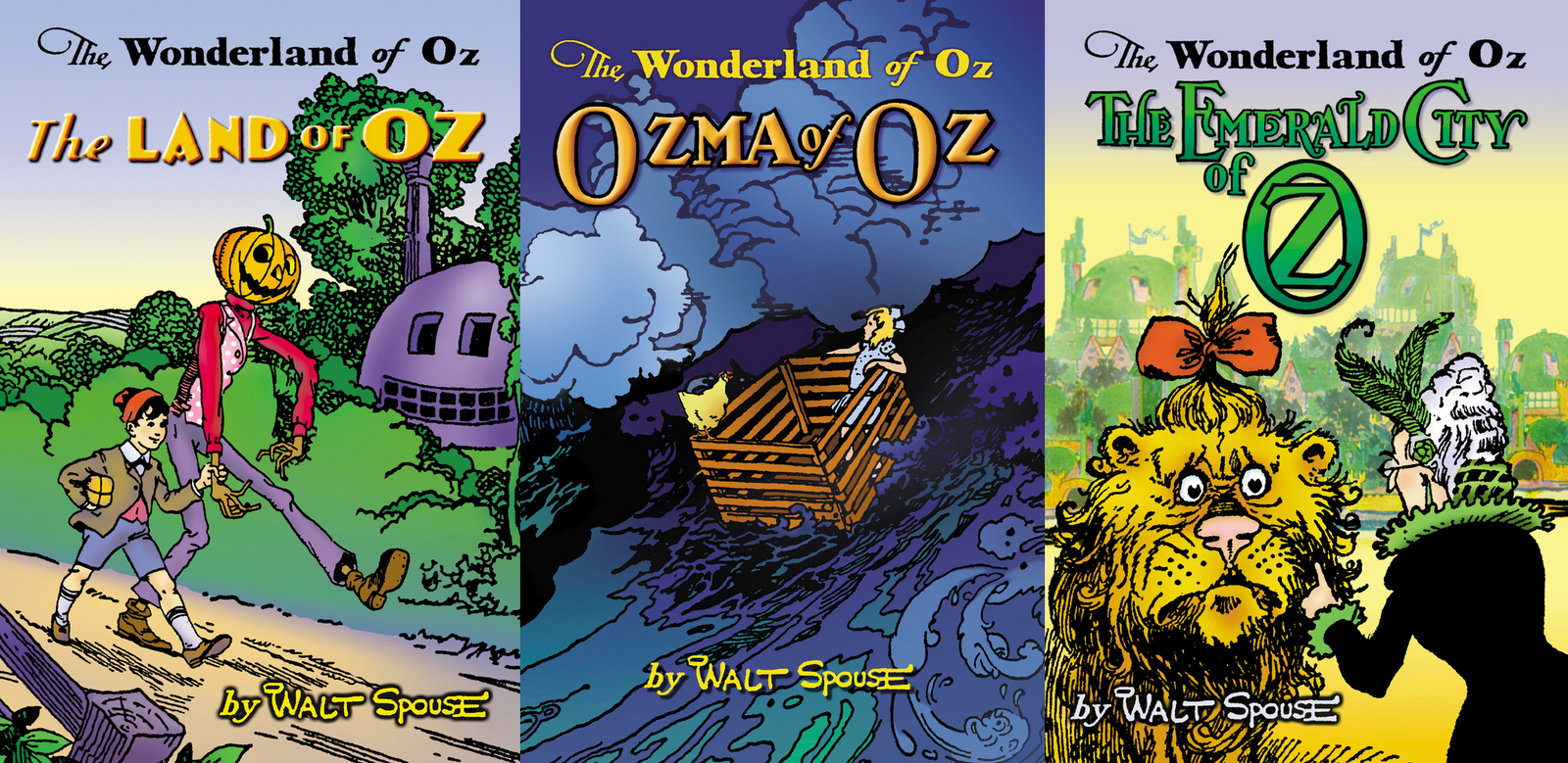
In 1932, Reilly & Lee attempted a new Oz publicity stunt: a comic strip. The Wonderland of Oz was serialized in newspapers through 1932 and 1933 and Reilly and Lee even offered a collector's album for children to put the comic strip. (If anyone has one of these albums, I'd love to see a photo of it.)

Now, these were not comic strips as we know them today, but pictures that told the story with text underneath. Here's an example:
You might note that it says "Based on the stories by L. Frank Baum and Ruth Plumly Thompson." Apparently there were some lofty plans for this series. However, these strips only adapted The Marvelous Land of Oz, Ozma of Oz, The Emerald City of Oz, The Patchwork Girl of Oz and Tik-Tok of Oz. Walt Spouse did the artwork, modelling his designs very much on the illustrations of John R. Neill. It's unclear if he wrote the text himself or if a staff writer did so. As it is, there are some changes that were made to the stories that required new text not found in Baum.

After the series' end, some comics were reprinted in comic magazines like "The Funnies." This time, word balloons with newly written dialogue were sloppily added to the artwork. Example:
And aside from some mentions in The Baum Bugle, the strip languished in obscurity for years until Hungry Tiger Press' first issue of Oz-Story Magazine in 1995. That volume presented a new version the first half of Walt Spouse's The Land of Oz, this time presented as a regular comic. Each panel was carefully redone by Eric Shanower, sometimes adding extra bits of art and writing in new dialogue based closely on Baum's text. Word balloons were carefully placed so as not to interfere with Spouse's original art, which was treated as the actual star of the presentation.
In the remaining five annual issues of Oz-Story Magazine, the rest of The Land of Oz, Ozma of Oz, and The Emerald City of Oz were serialized with identical treatment. The final issue announced the remaining stories would be presented in a collected edition of the entire series. Such a volume, however, has yet to emerge. (I think a contributing factor to this is that the guy who did the new adaptation and art restoration is extremely busy with things like Age of Bronze and now adapting the Oz books for a different comic series...)

In 2007, all three completed stories were released in single graphic novel formats with newly colored attractive covers. Since I'd already bought a complete set of Oz-Story Magazine, my interest wasn't too high since I didn't want a lot of duplicates of the same content in my collection, but I eventually picked them up at the Winkie Convention this year. (That anti-duplicate rule, I've given up on.)
Or maybe I'm a sucker for colorful Ozzy covers...
The stories are very faithfully based on Baum and would likely be a nice gift for children who've only begun to read. For experienced Baum and Neill fans, little is offered aside from the few changes (in these three) in the story and scenes that Neill never drew. As a bit of Oz history and quality comics, they're worth it. The Land of Oz and Ozma of Oz contain examples of previous incarnations of the comic strip.

Now, about these changes and things that Neill didn't draw? Well, there's additional moments from the stories that Neill didn't draw, but as Spouse retold the story through drawings, these show up. I'll only mention the most notable below.

The Land of Oz
  • Tip attempts to flee Mombi's house when she tells him she'll transform him into a marble statue. (Then why didn't she lock the door?)
  • The home of the Queen of the Field Mice is shown.
  • All of Mombi's transformations are illustrated. 
Ozma of Oz
  • No real story changes, but we get a comical drawing of the Sawhorse kicking the Nome King!
The Emerald City of Oz
  • The Shaggy Man does not exist in this version of Oz, so all of his scenes that really bear on the story are given to Uncle Henry or the Wizard.
  • The trouble with the bank is made clear not through prose but by a visit by a man from the bank.
  • Toto eats an elocution pill and sings from "The Barber of Seville"
  • Unlike Neill's illustrations, we get to see the Phanfasms in their true forms.
  • The creation of the barrier of invisibility is omitted. Shanower's text accompanying the Scarecrow, Tin Woodman, and Jack Pumpkinhead walking home says, "Come see us soon, for we shall not have any more adventures for awhile." (Come on, Scarecrow, you live in the Land of Oz.)
So, would I recommend buying The Wonderland of Oz? Yes. It's an important part of Oz comics history and Oz art. In addition, if you read them alongside the new Marvel comics, it's fun to see Shanower's different adaptations of Baum's text in The Land of Oz and Ozma of Oz. And with Christmas coming up, if you have a kid on your Christmas shopping list who you'd like to introduce to Baum's Oz beyond The Wonderful Wizard of Oz, these would make a nice introduction! And they're not badly priced at $10 each.

You can order the graphic novel collections from Hungry Tiger Press with the links below:
The Land of Oz
Ozma of Oz
The Emerald City of Oz

Here's hoping we might finally get to see Spouse's The Patchwork Girl of Oz and Tik-Tok of Oz!

All images are from the Hungry Tiger Press editions of The Wonderland of Oz. Copyright Hungry Tiger Press.

    Nuts!

    If you've been enjoying my blogs about Oz books, movies, etc. here at the Royal Blog of Oz, I've got something on my non-Oz blog that may interest you.

    It's no secret that Oz is considered the first American fairyland, but of course there were fantasy stories that featured children visiting magical lands that preceded it. Right off, Alice in Wonderland. But there was a little German fantasy story in 1816 that was largely neglected until the late 19th century when it was made into a ballet. I'm speaking, of course, of E.T.A. Hoffman's The Nutcracker and the Mouse King.

    Frankly, I've loved this story since I was a kid, and this year, prepared 18 blogs about various incarnations of the story throughout the years. They'll appear daily, early in the morning, Central Standard Time. And since they've been written early and will appear automatically, they won't take me away from writing for the Royal Blog of Oz at all.

    If you're interested, go on over to my non-Oz blog and check them out, starting December 1st. There'll be a final blog on the 19th.

    (Maybe next year I'll tackle another Christmas story that's been retold many ways...)

    Monday, November 28, 2011

    Mister Tinker in Oz - Sam's Retrospective

    Two months ago Jared made a review about the Random House Oz Short Story "Mister Tinker in Oz" by James Howe, illustrated by David Rose. You can see his review of half the book here.

    As Jared said before I have this book in my collection and would like to offer my perspective.

    Everybody knew the story of "the Wizard of Oz", or at least knew the LOOK of the story (a girl, a dog, a Scarecrow, a tin man with an axe, a lion, all walking together down a road of yellow bricks, usually to or away from a city of emeralds). Of course we had the Ladybird story as an abridgement too (illustrated by Brian Price Thomas) at my primary school library, Daceyville, but surprisingly we also had a copy of this blog's book, the cover () of which has always stayed with me since, including some of its illustrations. Not everyday that you have an abridged Oz book that's by an author NOT Baum, Thompson, etc!

    I was too young to really read the book, so like all little children I just looked through the book unless I saw a picture, which there is a good number of - but you can never have enough or too many pictures as a kid!

    For many years I remembered a few of the images from the book: the colour cover having a girl with her long hair in braids standing at a fence as she watched a man in a black cloak coming down a ladder from the clouds/sky, Dorothy sitting with a group of babies surrounded by giant ants, Dorothy and the babies now with the man, Dorothy looking at a clock the man showed her in his hand and finally Dorothy resting in an armchair with Toto (and a book?) in front of a fireplace.

    Only once did I go on the internet, find "the Oz Project" and come across the interesting title did I find the book I remembered only through pictures and not words. It would not be until July-August 2006 that I ordered the book, not from ebay, but an online secondhand-bookstore called BiblioQuest.

    I loved the book soon as I got it. And, as is often the case with memories and time, I saw how the drawings were slightly different to what I imagined: Dorothy's hair wasn't as long as I thought it was, nor did Mister Tinker look like a Clown in a black cloak. And of course now that I had grown up, I could actually read the book and remember the story - there is also an extra character, an old lady named Astoria who I thought looked like the Good Witch of the North in her one illustration (before actually reading this time), who helps add to the story.

    I don't need to tell you what happens as that was already explained in Jared's blog, but I can say how the best thing about this book is that there is adventure not just in getting to Oz but also after having arrived in the Emerald City. Most importantly Dorothy helps Mr Tinker to find there was nothing wrong with him throughout the story after all. A big cliche is the asking of "Will Dorothy get home again?" or "Will everything be alright?" and that is actually addressed here, in which the Emerald City ISN'T "alright" upon visiting, so that allows the story to go on a bit longer with Dorothy and Mr Tinker and their friends all helping Oz to become normal again.

    A GOOD Short Oz story, with sketchy illustrations but still some nice drawings nonetheless, which brings a backstory character to the spotlight (Tik-Tok's creator) in a simple yet extremely fun adventure in Oz. I should like to see this book as a short film someday, if possible. And maybe try some new illustrations too.

    I wonder though, if L. Frank Baum had remembered Tik-Tok's story of his creators back in "Ozma", would he have thought of a way to include the 1000 year warranty and its moon-based creator in "Tik-Tok", in the rewrite of the Ozma Musical?