Showing posts with label MGM's The Wizard of Oz. Show all posts

Wednesday, November 20, 2024

The Mysteries of Oz documentary review

 You might have noticed that I lamented that Warner Brothers was not really doing anything to take advantage of the 85th anniversary of MGM's The Wizard of Oz and the hype around the film adaptation of Wicked. (To recap, we got a steelbook repack of the 4K edition that offers nothing new for a very premium price.)

The saltiness of my opinion burns even more while watching The Mysteries of Oz, a 3-episode documentary available for purchase exclusively through Amazon Video for $9. Because, why was this on Amazon instead of getting a release on Max? It's not made by Warner Brothers, but given the use of clips from the MGM film, they had to have licensed it.

AMS Films is the producer behind the documentary, doing three episodes instead of a massive nearly 3-hour documentary. It's a good choice as it allows you to pace your experience, while also allowing you to binge it if you wish to watch it all in one go.

The documentary is presented as a countdown of eighty-five questions about Oz, mostly centered around the MGM film. Answering them are a number of familiar faces to me. Representing the current generation of Oz fans are Tiffany Sutton (followtheyellowbrickgirl on Instagram), Sean Barrett (art director for the Land of Oz park), Victoria Calamito (Tori of the Oz Vlog), Nichelle Lewis (Dorothy from the most recent Broadway production of The Wiz) and Tara and EmKay of the Down the Yellow Brick Pod podcast. We also get Jay Scarfone and William Stillman, who have written four well-researched books on the MGM film. There's also drag performer Ginger Minj, who does her answers almost as a standup routine in front of an audience. There's also Books of Wonder's Peter Glassman, Jane Lahr, Bert Lahr's daughter, Ryan Bunch, current president of the International Wizard of Oz Club, and Gregory Maguire, author of Wicked: The Life and Times of the Wicked Witch of the West and its three sequels, the "Another Day" trilogy, Tales Told in Oz and the upcoming Elphie. Other experts, including Joey Luft and surviving child Munchkin cast members, are also involved.

If you want to know about factual accuracy, nothing really stuck out to me as being inaccurate, so let's get that out of the way. The talking heads do a great job of answering, being concise, giving more context when needed, keeping up the energy very well, as well as the use of relevant film and video clips, images, and even an audio clip of Bert Lahr's hosting the first telecast of the MGM first with Liza Minnelli. (I was very surprised to hear that.)

The documentary does a great job of addressing the myths around the movie as well as more about Oz lore. I wish there had been a bit more about Oz fandom and the international impact of Oz, but hey, even three hours and 85 questions about Oz can't do everything.

In addition to being informative, this was a great celebration of the MGM film and Oz as a phenomenon. It just about makes up for Warner Brothers not really doing anything. Just about.

You can find out more about the documentary on their website.

Also, here's a link to the documentary on Amazon.

Friday, March 01, 2024

MGM's The Wizard of Oz gets a new rating


 So, over in the UK, MGM's musical film The Wizard of Oz is getting reissued to theaters.

As a part of the process of reissuing the film, it is sent to the BBFC—the British Board of Film Classification—for reclassification. "Classifying" a film for the UK works like the MPA—the Motion Picture Association—in the US. The film is given an abbreviation with a recommendation about the audiences the film would be best suited for.

"U" in the UK is "Universal," meaning it's fine for anyone to watch, similar to the US' General audiences or "G" rating. Next is "Parental Guidance" or "PG," which is the same in the US, that there are some elements that might require adults to help their kids process. The UK's "12A/12" is a similar to the US' "PG-13," in that the film is not recommended for audiences under the age of 12 or 13. (12A is for cinema releases, while 12 is for video releases.) The analog to the US' "R" or "Restricted," indicating intense subject matter is a little more varied with 15 and 18 ratings, recommending them for those ages and up.

In any case, what's been making news is that The Wizard of Oz was previously released under a "U" classification and is now being classified as "PG." The reason is for "offensive language."

This took Oz fans by surprise as it's a film from 1939, what offensive language could there be?

The answer is during the song "If I Were King of the Forest," the Cowardly Lion states the line, "What makes the hottentot so hot?"

I was aware of this line as the word "hottentot" is similar to "Tottenhot," a controversial group in the book The Patchwork Girl of Oz. Baum clearly flipped some letters around and put a parody of an African tribe into an Oz book.

And you should already guess what a "hottentot" is, a derogatory term for a stereotype of an African native, depicted as an animal skin-wearing person who is hostile, not intelligent, being compared more to an animal than a human being. It seems it originated from Dutch people about the Khoikhoi tribe of southern Africa, who used a lot of clicking sounds in their language, sounding to the outsiders like stuttering, or "hotteren-totteren" in German.

You should already get why this word is considered offensive. While it's largely fallen out of general use, it was a common term thrown around that got alluded to in the Oz books and actually popped up in the most famous version of Oz.

As we've begun to respect the humanity of more groups given our increasing communication between societies thanks to widespread media and the internet, derogatory terms for people have begun to be seen as unacceptable in civil conversation. It says less about the people who these terms are meant to describe and more about the people who continue to use them. We recognize people as people, acknowledging their different cultures and backgrounds. If you use terms that have been historically used to deride groups, you're basically trying to keep that tradition alive. People aren't offended that you hurt their feelings, they're offended that you're being a jerk.

So yeah, essentially, the rating changed because of a word that's been there all along. Most of us didn't give a single thought to the word when we first saw the movie and likely most young audiences wouldn't either. But a lot of us are likely people who this word wasn't meant to describe. The people who it does are people too and they deserve their dignity.

May I add that the new classification isn't banning the film, it isn't suggesting that people not watch it, it simply tells people that there's a topic in here parents might want to handle with their kids.

And remember, the MPA actually gave The Wizard of Oz a new rating when the 3D version debuted in 2013, the scare factor of the Wicked Witch and the Winged Monkeys increasing the rating from G to PG.

And ultimately, the classification recommends parents watch the movie with their kids, and isn't a family enjoying the movie together one of the best ways to watch it?

Tuesday, October 15, 2019

A Tale of Two Wizards

This is a feature article I wrote for the Winter 2014 issue of The Baum Bugle discussing the differences between L. Frank Baum's The Wonderful Wizard of Oz and MGM's famous film adaptation The Wizard of Oz. Rather than simply point out what the film did differently than the book, this article's intent was to explore these differences and why they were made, asking audiences to enjoy both versions of the story. I must thank then Bugle editor Craig Noble in helping to make this piece quite accessible to readers, though I've made some new edits in this posting.
“Hey, Jared,” my mother said one night. “There's a movie coming on TV, and I think you'll like it.”

“What's it called?” my seven-year-old self asked, walking into the living room.

“The Wizard of Oz.”

For the next two hours, I was rooted to the living room floor, watching the incredible story of how a girl from Kansas was taken to a fantasy world and met some amazing friends and faced a scary witch. I was fascinated.

Shortly after, my grandfather was moving to a smaller house and asked my father to pick up some of his childhood books. I wound up tagging along and discovered a familiar-looking book: the Grosset and Dunlap Illustrated Junior Library edition of The Wizard of Oz by L. Frank Baum, illustrated by Evelyn Copelman. Later, I fished it out of the garage, and after a disastrous attempt at borrowing the MGM film on VHS from the library (resulting in a broken VCR), I decided to read the book for myself.

I read the book over several days and was quite enchanted by it. More Oz! More characters! More adventures! Of course this version was better, right?

That was twenty years ago, and by now I've read all of the Famous Forty Oz books and then some, as well as seen most of the film and television adaptations of the Oz stories. I've also seen some of my other favorite stories become movies and even taken a shot at a writing a few screenplays. Consequently, I often think about the adaptation process from book to film.

One rule that modern screenwriters seem to cite is, “Don't change the story, change the storytelling.” While this rule has been commonly cited only in recent years, when we look back at MGM's classic film adaptation of The Wizard of Oz, we can see that it has been in place for a very long time.

I've come to realize that saying one version of the story is better than another—no matter what well-worded reason you may cite—is failing to appreciate both versions for what they are. Books and films are very different mediums, and what works in one often will not work in the other. A book requires one to use imagination: what do the characters look like? How do they sound? What about buildings and landscape? A typical film adaptation offers a single interpretation of these missing elements, which may not match what the reader imagined.

A bigger difference between books and film—particularly evident in the case of The Wizard of Oz—is the pacing. Baum's The Wonderful Wizard of Oz is a chapter book with children in mind as the target audience. Children would not be expected to finish the entire book in a single sitting, whether they were reading it themselves or having it read to them.

Baum promises in the introduction to to present stories “in which the wonderment and joy are retained and the heart-aches and nightmares are left out.” This does not mean that the book is free from any violence or death, far from it! However, each chapter—with a couple of exceptions—ends with Dorothy and her friends being relatively safe. Scary situations are routinely dealt with by the end of each chapter, resulting in an episodic narrative style.

Unlike books, films are designed to be taken in during a single sitting, presenting as a continuous story. This often calls for a more linear narrative style, and it may require the dropping of certain plot elements. In the case of the MGM Wizard of Oz, a rather large overhaul was required.

By modern standards, it is perfectly all right for a film to dip into fantasy, even setting the bulk or the entirety of the plot in an unreal world. In 1939, however, such movies were scarce. Snow White and the Seven Dwarfs was set in a magical version of Europe in the past. Laurel and Hardy's Babes in Toyland presented a fantasy based around familiar nursery characters paired with the comedy duo’s typical shtick. Since the bulk of The Wizard of Oz takes place in a world with good and wicked witches, flying monkeys, unreal landscapes, and some very non-human characters, it was decided to ground the film in the realm of reality from the start. In order for audiences to accept this fantasy world, MGM needed to open the film in a world that was believable and possibly even familiar.

MGM also was inspired by Paramount's disastrous 1933 adaptation of Alice in Wonderland. While the movie was a charming adaptation of Lewis Carroll's book, the film studio made a huge mistake in casting big stars and making them unrecognizable under bulky masks. The film was a flop and spelled near ruin for Paramount. If famous movie stars were going to play the Oz characters, then the audience needed to be able to see and recognize them.

Thus, we have the opening set in sepia-toned Kansas, where Uncle Henry and Aunt Em have ordinary worries, such as possibly losing chicks due to a broken incubator, and most of the key Oz characters are suggested by familiar personality types—farmhands, a nasty neighbor, and a tricky showman. We are presented with a reality that audiences in 1939 could easily relate to, and faces that they could recognize. When these faces reappear in Oz under character makeup, we can still see who they are and connect them to the characters from Kansas.

Furthermore, the Kansas scenes foreshadow the new linear plot adaptation of the Oz story: Dorothy and Toto are threatened by a cruel female character, are helped by some friends, and travel to see a man who sends Dorothy back on the road home.

In Baum's book, Dorothy meets two powerful women in Oz who appear at the beginning and end of her journey: the Good Witch of the North and Glinda the Good. One could make many arguments for the significance of keeping these characters separate, but for the purposes of MGM's film adaptation, the two are combined, the former receiving the latter's name. Glinda was a popular character in the Oz books, and leaving her entirely out of the movie would have been nearly unthinkable. Yet introducing her in the film's final moments would have proven problematic to the linear adaptation, so the characters were combined. A downside to this change in the story is it begs the question of why Glinda quite willingly withholds critical information from Dorothy and sends her on a dangerous journey.

In contrast to her one-chapter appearance in Baum's book, the Wicked Witch of the West is redeveloped into a recurring threat to Dorothy in the film. The Wicked Witch of the East’s magic footwear is transformed from the book's silver shoes to the movie’s iconic Ruby Slippers. After Glinda gives them to Dorothy, the Wicked Witch of the West targets the girl and threatens her throughout her journey.

Perhaps the most altered character is Dorothy. In the book she is of an indeterminate—but likely prepubescent—age. The character played by the sixteen-year-old Judy Garland is supposed to be twelve, but she clearly looks older. In another change, Dorothy is a rather reserved child in the book, whereas in the film, she runs away from home and even scolds the Wizard when he scares the Cowardly Lion. This is not to say that Judy's Dorothy is consistently bolder than Baum's. She has her weak moments in the film, such as when she's trapped in the Wicked Witch's castle with nothing to do but wait for rescue or death, and her defeat of the Witch is only by accident. In contrast, Dorothy defies the Wicked Witch in the book by feeding the Cowardly Lion and later throws the fateful water at the Witch because she's had enough of her.

Dorothy is given a character arc in the film, whereas the book simply tells her adventures in an episodic fashion. Baum didn't set out to moralize with his story, but the film clearly has a moral as evidenced by the Tin Man asking, “What have you learned, Dorothy?” By the end the film, Dorothy has found a new appreciation for her home and family, but it’s near the beginning of the book (shortly after meeting the Scarecrow) that Dorothy states, “There is no place like home.” Her desire to return home is always inspired by her love for her guardians.

MGM based its approach to The Wizard of Oz on previous adaptations of Baum's story. It borrowed freely from the most famous adaptation of the story at that time: the original stage musical from 1903. For example, rather than attempting to depict the rescue from the poppy field by the field mice, MGM borrowed from the musical's grand Act One finale and had Glinda send snow to kill the poppies.

The encounter with the poppy field is the only one of Dorothy's adventures along the Yellow Brick Road that is included in the film. This is partly because it would have been too difficult to film most of these scenes in a visually interesting manner. (Does anyone really want to see Kalidahs that are just men in costumes?) Another reason is the linear plot adaptation removed the need for these episodes by placing the Scarecrow, Tin Man, and Lion's needs to prove that they always had the qualities that they were looking for themselves into the expanded mission of defeating the Wicked Witch.

A number of elements from the book are moved to other points in the film’s chronology. In the book, Toto bites the Wicked Witch, while in the film, it is the Witch’s Kansas counterpart, Miss Gulch, who reports that this has happened to her. The Fighting Trees encountered during the final journey to Glinda’s palace in the book become the Apple Trees that lead Dorothy to find the Tin Man in the movie. The bee swarm that originally attacked Dorothy’s friends is referenced by the Wicked Witch in a threat to the Tin Man in the film.

Some elements from the book appear in the film briefly, though their importance is not mentioned in dialogue. For example, we see the Wicked Witch with the Golden Cap in one scene in the movie, but its importance is never brought up. In a similar vein, Glinda kisses Dorothy's forehead, but we are never told whether it has a magical purpose. (Given that the Witch attempts to kill Dorothy with a spell, we might presume that it does not.) The Winkies have spears as weapons, and the Witch sends them to attack Dorothy and her friends much like she did in the book.

Other changes were made for stylistic reasons. Scarcely any dialogue from Baum's book is carried over into the movie. The movie uses the precedents established by the 1903 stage production as a license to tell the story as a musical, in which songs are used as a vehicle to establish characters or move the plot forward. The story must keep moving, and even when Dorothy and her friends take time to sing about their desires, the lively songs are accompanied by choreography and cinematography so the audience doesn't feel like they're just listening to a song.

Although the MGM production took many design cues from W.W. Denslow’s illustrations, few of the character costumes resemble their book counterparts. Given that the movie Munchkins have doll-like figures, it has been suggested that perhaps they were supposed to bring to mind the Dainty China Country. Further cosmetic changes are made as well: the Munchkins and Winkies do not have cultures based around colors and the Wicked Witch does not have an eye patch or a far-seeing eye, but instead green skin and a crystal ball.

So, while both the book and film tell of how a Kansas girl goes to an amazing fantasy world and meets new friends and defeats a Wicked Witch on her quest to return home, they tell it very differently. It is the opinion of this writer that each should be appreciated for its own approach, rather than being pitted against the other. After all, they have delighted readers and audiences for one hundred nineteen and eighty years respectively.

Friday, August 23, 2019

The Wizard of Oz 4K - October 29, 2019

Preorders for a 4K edition of MGM's The Wizard of Oz are now available, dated for October 29, 2019. The movie will have the distinction of being the oldest film on the UHD format.

4K Blu-Ray or UHD (Ultra High Definition) is the latest physical home video format, with an image width of nearly four thousand pixels allowing for clear detail and HDR processing allowing for more vivid color range.

Warner Brothers has yet to detail this new edition, but the lack of a moratorium on previous editions of the title should let fans and collectors know that this is simply a 4K release of the movie.

Many 4K titles—both new releases and catalog titles—are released with a 4K disc that usually contains only the movie in 4K with HDR, looking simply amazing. It's basically a case by case basis as to if alternate audio tracks such as audio commentary are included. No bonuses are usually on the disc. (There have been 4K discs with some bonuses included on the 4K disc, but the ones I can recall reading about were from Lionsgate and Sony, not Warner Brothers.)

Included is a standard Blu-Ray disc, which, for catalog titles, is usually a copy of the latest edition of the title. There are cases (including Warner Brothers) in which the disc is a new one. Also standard for US releases is a digital copy code to redeem for a 4K digital copy so you can stream and download the title. (You will be able to purchase the digital 4K version on October 29, but people who bought or redeemed their previous digital copies via iTunes have reported that their copy has been upgraded.)

Best Buy exclusive Steelbook edition.
While there might be a new Blu-Ray included, I think Oz fans should only expect the new 4K disc. There's currently no new "big box" Ultimate Collector's Edition announced as was released the past two major times the movie was released to home video. The Ultimate Collector's Edition of the past release was the only new way to own a whole two additional discs of bonus features.

So yes, unless a collection with three or four discs is announced, this will include fewer bonus features than the last releases. In addition, the 3D edition is not included as 3D has become a small niche in the home video market, collectors being forced to either import international editions for the 3D disc or turn to exclusive retailer editions that have them. (If available.) So, for collectors who enjoy having the most bonuses available, this new edition should supplement, not replace your older editions. Don't expect new bonuses unless Warner Brother announces them.

I do want to say something about the artwork. It's stilted, looks far too clean and is generally not dynamic or very appealing. The best looking covers from the 2013 reissue were the 3D editions with just Dorothy front and center on the covers. (The 2-disc one featured her in a field of flowers against an Ozzy landscape, while the case in the big box edition featured her face against a white background with the title.) What baffles me is that this movie has been around for decades, with multiple excellent pieces of artwork being created for posters, merchandise and other home video editions. Given how I've used Photoshop, I decided to take a crack at creating alternate 4K covers.

This one repurposes artwork from one of the original posters in 1939, with Al Hirschfeld's portraits of the characters framing the left side and bottom of the front cover.

This one repurposes the artwork from the final MGM/United Artists home video release, circa 1997.

While I'm sure the 4K edition is going to look and sound amazing, especially with HDR, using artwork like that is certainly questionable. Better artwork has been produced for the film which I'm sure with only a little bit of work, Warner Brothers could use. Or there are a number of fine artists who could create new original artwork that would look much better.

Also, Warner, if you'd like to maybe also announce Dorothy and the Wizard of Oz: The Complete Series on DVD or Blu-Ray soon, I wouldn't be mad.

EDIT: UK retailers will be offering their own 4-disc collector's edition.
This set promises a dedicated special features disc in addition to the 4K disc and the standard Blu-Ray. It will likely be a reissue of the special features disc from the 2013 edition. The fourth disc will be a soundtrack CD. Also included are art cards, a reproduction poster and the "map" of Oz that was also in the 2013 big box edition. This set looks very pretty, so UK fans and collectors should be quick to snatch it up, and collectors outside of the UK might want to contact fellow UK collectors to help them get copies as well.

EDIT: Wow! An official press release from Warner Brothers is out there now. It confirms that the Blu-Ray disc will have all the same features from the 2013 edition. It is possible that the version of the film on the disc will be sourced from the 4K version, but that will likely remain unseen until the disc is released and reviewed. There is no mention of a standard Blu-Ray reissue.

The press release confirms that there will be two bonuses on the 4K disc: the audio commentary and the 1990 special The Wonderful Wizard of Oz: The Making of a Movie Classic, hosted by Angela Lansbury. This special was included with every Warner Brothers home video release of the movie from 1999 to 2009, but was dropped in 2013 in favor of a new documentary they'd created. After a lawsuit from the producers of the documentary, it was released on its own DVD as part of the Warner Archive Collection. Now, the 4K disc will include it.

Thursday, August 15, 2019

The Wizard of Oz songs on vinyl

Well, the 80th anniversary of the premiere of MGM's The Wizard of Oz is today. Looking back over my blogs about Oz vinyl records, I noticed the soundtrack album of the movie was unrepresented.

Well, let's fix that, shall we?

In 1940, the songs from The Wizard of Oz were released onto 78rpm records for fans of the film to purchase. However, this was not a soundtrack album. A soundtrack release is made of selections from a film's music, sometimes mixed differently or even using different recordings of the music designed to be listened to without the film.

This release, from Decca Records, featured new recordings of the songs, and only one of the cast could be heard: Judy Garland, singing "Over the Rainbow" and "The Jitterbug." The rest of the singers on the records were members of the Ken Darby singers, under his direction. Victor Young and his orchestra performed the music. The other songs on the records were "The Merry Old Land of Oz," "If I Only Had A Brain" (but it also included "If I Only Had A Heart" and "If I Only Had The Nerve"), "We're Off To See The Wizard" and "Munchkinland" (the entire song sequence, filling both sides of a 78 record).

These recordings used some additional lyrics for the songs not used in the film. These were added to commercial sheet music to help the songs be performed outside of the context of the movie. To help tell the story of the song during "The Merry Old Land of Oz," a soloist in the role of Dorothy says "We can't see the Wizard like this, we're all dirty." The Tin Man says he's rusty and the Scarecrow says he's lost a lot of straw, while the Lion says he's afraid of water. The chorus sings "Here we rush with soap and brush to make you clean and fair!" This line has been added to some other versions of the song, for example at the first OzCon karaoke in 2018, I was surprised to see it in the onscreen lyrics for the version of the song I performed.

This collection of records sold well for Decca and in time was reissued as a pair of 48rpm records. Later still, it made side one of a new album that paired the songs with Decca's recordings of a similar collection for Disney's Pinocchio. And that is the version I own.

The first true soundtrack recording of the movie was released in 1956, but unlike modern soundtrack albums, it presented dialogue from the film along with the songs. This meant it included a lot of the score, but it was clipped very short to reduce the audio from 101 minutes to a mere 40 minutes. A number of scenes got the cut, and oddly, the cuts eliminated any mention of the film's iconic Ruby Slippers. For the modern Oz fan, the original version of this album can be very jarring to listen to. Still, for many years, to hear the original cast of the film sing the songs without seeing the film in theaters or on television, creating an audio recording from TV or somehow owning a film print (looking at you, Rob Roy MacVeigh), this was your only option.

This version of the album would be reissued many times with very different album artwork over the years until compact disc came along. It was rebranded "The Story and Songs of the Wizard of Oz" and expanded. My personal vinyl copy seems to be a rather common one that was reissued well into the 1980s.

In 1995, Rhino Music released two new soundtrack albums for MGM's The Wizard of Oz on compact disc. The big one was a 2-disc set that I've profiled before, but there was also a single disc version that in time has become more widely available. This one featured the main titles overture, the songs of the film—opting for extended versions when available—, the Cyclone music, "The Jitterbug," the deleted Emerald City reprise of "The Witch Is Dead!" and the finale music. This version of the soundtrack is now the standard version and has been released on various CDs, digital and even some special vinyl releases.

Do you have these versions of the MGM songs in your collection? In what format? Go ahead and fire away in the comments.

Thursday, April 04, 2019

GoFundMe OzCon Campaign

OzCon International is just a few months away, held on July 26-28 at the Kellogg West Conference Center.

This is certainly a BIG one: Celebrating the writings of L Frank Baum (who passed away in 1919) and the 80th Anniversary of MGM's "Wizard of Oz"

Everybody loves to go, though sometimes there are those who may have a little difficulty doing so, whether it's due to money or distance.

That is why I have made this campaign to ask for help, so that I may not miss out on this special event.

Normally I rely on myself and don't ask for assistance, but there are times you need to take a chance and ask for help, then see who is willing and able to help.
It's a reasonable goal and will cover the main expenses: travel, accommodation and spending.

If all goes well, some of the extra money may go to attending next year's OzCon in 2010, to celebrating "Glinda of Oz".

If you are able to help donate and spread the word around for this, that would truly show the spirit of the Oz community - where you help someone, just as Dorothy selflessly helped the Scarecrow and the Tin Woodman get out of their positions through the goodness of her own heart.

https://www.gofundme.com/help-me-attend-ozcon-2019


Please and Thank you.

Thursday, January 10, 2019

Oz in 2019!

Happy New Year everybody!

Sorry for the lack of posts lately from all of us (and for those of you who don't like keep hearing "happy new year" after a week).

Calendar by the International Wizard of Oz Club, each month focusing on a certain possession of a different member with a story

Oz has a few specials this 2019:
* 100 years since L Frank Baum died on May 6, 9 days before his birthday, before his penultimate book "Magic of Oz" was published
* 80th Anniversary of the 1939 MGM film

More updates and Announcements will be declared once information has been known.

Personally, I will making work on MANY Oz illustrations for a few story / book-related projects as well as continuing with my Oz-related commission (check out "Devotion" on DeviantArt to find out - there should be 14 pages, so just check my page for any missing pages - Hand-Sam-Art).

There are also some new Oz books I have and will be reading soon, so when I can I may provide reviews.


Not much to read now, but a small update never hurts.

Here's a good one for all of us and Oz this year!

Tuesday, September 04, 2018

Oz news! The Ruby Slippers are finally all accounted for!

Of all the existing costumes and props used in MGM's The Wizard of Oz—which will have its 80th anniversary next year—the most iconic have been the Ruby Slippers. Audiences thrill to see the sparkly red pumps on Judy Garland's feet throughout the film, at first taken from the Wicked Witch of the East, then given to Dorothy, which makes the Wicked Witch of the West target her. At the close of the film, Glinda reveals these very shoes were Dorothy's ticket home the entire time, having her tap her heels together and say the now iconic line, "There's no place like home."

The film had changed the shoes from the book's Silver Shoes, deciding that a sparkly red looked better than shiny grey. The effect was created by sewing sequins onto shoes made by the Innes Shoe Company of Los Angeles, dyed a dark red. In addition, bows studded with false glass gems were added.

No one knows how many pairs of shoes were made and used in the film. The producer once gave a figure of "from five to ten," a wardrobe department employee offered a number of six. The need for so many is easily explained. Judy's stand-in and double also needed pairs. Judy's feet would swell after filming in the morning and she would use a slightly larger pair later in the day. And if something happened to the shoes, if they became damaged, there would be a backup so the crew could simply change pairs and continue with filming. Some pairs had felt on the soles so when Judy had to dance, the felt would muffle the sound of them hitting the stage. At least one pair didn't have felt as the soles were seen in the film without them.

One test pair with a notably different design, including curled toes, is known to exist. Of however many pairs were made and used in the film, we only know about four pairs. Counting the test pair which wasn't used in the film, that makes five pairs.

These pairs were found by one Kent Warner as he was preparing for a major auction of MGM studio memorabilia. One of these were auctioned off in that auction for $15,000 in 1970. It seems that this is the pair that was recently conserved by the Smithsonian and will soon be back on display. Warner sold the test pair to Debbie Reynolds, and they were auctioned off in 2011. Another pair is in a private collection. Warner's own pair was eventually sold to a collector who used them for charitable purposes and let the Smithsonian display them as a substitute when their pair was elsewhere. This pair was sold in 2012 to become an asset for the upcoming museum by the Academy of Motion Picture Arts and Sciences. Among the people who donated to purchase this pair were director Steven Spielberg and actor Leonardo DiCaprio.

And so we come to the most scandalous pair. Collector Michael Shaw loaned his pair to the Judy Garland Museum of Grand Rapids, Michigan (Garland's hometown). In 2005, the pair was stolen with hardly a trace as to the culprit or where to find them. The theft caused a sensation for fans of the MGM film, Oz at large and Judy Garland. There were much publicized searches for the stolen shoes involving flooded mine shafts and other places. Theories flew wild, I even reviewed a novel that presented a first-person fictional account of the theft. A documentary about the Ruby Slippers and the case was made. Some believed Shaw needed money and was holding out for the insurance payout, and given that it had been so long, he did indeed get the payout. (I state this not to accuse Mr. Shaw who I genuinely believe was grieved over the loss, but to state a theory and the fact that the payout did occur.)

Oz fans got the news today that after thirteen years, the stolen pair had finally been recovered by the FBI. It seems arrests of the culprits have yet to be made, so the full details of the case have not been revealed. What has been revealed is that they were recovered in a sting operation over the summer, which resulted from an extortion attempt (a "we'll give them back if you pay us" situation). A conservator from the Smithsonian who had been working on their pair of Ruby Slippers assisted in authenticating the recovered goods.

It appears that the long term plan is to restore the slippers to public display, however as the investigation is ongoing, the FBI is holding them as evidence.


In some other news, it is the 40th anniversary of the film adaptation of The Wiz, starring Diana Ross and Michael Jackson. Looks like we're not getting a 40th anniversary 4K Blu-Ray or any special merchandise or reissues. To be fair, the film didn't recoup its budget, but it proved to be a big enough seller on home video that it was released on three Region 1 DVD editions (fullscreen, widescreen, anamorphic widescreen in 2008), and got upgraded to Blu-Ray in 2010, a fairly short time into the format's life. In addition, it's been subject to many airings on television as well as a handful of special film screenings.

And The Royal Blog of Oz would like your thoughts on the movie! We'd like to get a variety of perspectives on it. Love it? Like it? Hate it? Neutral? Let us know.

You can comment on this post or send an email to scarecrowandtinman2002@yahoo.com. Your commentary will be posted in a special blog entry and your name (or a pseudonym if you prefer, please specify) will appear with your comment. (I reserve the right to edit content appearing on the blog.) The plan is to release the blog within the next two weeks.

Saturday, August 25, 2018

The Wizard of Oz - A Music Video Tribute

I had planned that at OzCon this year, we would follow a panel with Barry Bregman and Christianna Rickard reflecting on their relatives involved with MGM's The Wizard of Oz with an original music video tribute to the movie, featuring the beloved song "Over the Rainbow" and "The Reprise" from Meco's Wizard of Oz disco album. However, things got shifted around and it wound up being one of the last things we showed on Sunday. But thanks to YouTube, now anyone can see it. It was my first time editing in Vegas and I had to learn the software while making this video.

Editing the "Over the Rainbow" part at the beginning was a little difficult in that I realized just how magnetic Judy is during it. She has a lot of presence during this song and it's hard to take your eyes off of her. So deciding when I would cut away to clips from later in the movie was a little tough. I think it works rather well and the Over the Rainbow portion works as a video all on its own.

The second half was a real challenge to time everything correctly and not linger on shots for too long. I really like the Wicked Witch montage, though.

Sunday, February 04, 2018

Andrew Lloyd Webber's Wizard of Oz

Andrew Lloyd Webber's stage production of the MGM Wizard of Oz finally made its debut in Australia at the beginning of 2018 (Capitol Theatre in Sydney until February 4, before moving onto Adelaide for April 3 and Melbourne May 15).

Facebook Website

Glinda's dress was WONDERFULLY Sparkling from afar!

This is the version of the 1939 take where Andrew Llyod Webber and Tim Rice added new extra songs to the story and a few other changes or revisions (possible SPOILERS):

* Dorothy sings "Nobody Understands Me" first,
* Miss Gulch arrives and leaves before Dorothy sings"Over the Rainbow",
* Professor Marvel sings "Wonders of the World" before the storm hits - it is at this moment Dorothy says she'll give Toto to Hunk to protect him from Miss Gulch
* During the Cyclone (an impressive, loud and thrilling scene) with the family and neighbours looking for Dorothy but also taking shelter from the storm (which was projected onto a screen on stage in front of the characters), the audience "rode" alongside Dorothy (who is not seen getting knocked unconscious by her window) as the house was lifted up into the funnel, up through the clouds with the Wicked Witch of the East flying past the window, as the house ascended into the atmosphere, before slowly heading back down "to earth" before falling into Munchkinland - Dorothy had apparently fallen out of her room and bed, landing on the ground outside her damaged house, with darkness surrounding her until Glinda appeared revealing a bright and colourful landscape ... and the sparkling footwear beside her.
* the Munchkins do wear Blue (and their clothing patterns do look like the blue willow dish), although they are not as funny or dolly or silly as the actual film's look, so characters like the Mayor, the Coroner the Lullaby League (three mothers each with a baby wrapped up) and the Lollipop Guild do not stand out from the crowd until their own musical cues
* in the Emerald City:
 - Dorothy blue-and-white gingham literally changes to GREEN-and-white on stage,
 - the Wicked Witch of the West does not appear to threaten the friends after the Tin man's rescue, nor does she skywrite "Surrender Dorothy" but does stand on a side balcony and uses a loudspeaker to warn the Citizens to spare themselves by surrendering Dorothy to her,
* the Wizard sings "Bring Me the Broomstick", which closes Act 1 (there is no "If I Were King of the Forest" number).

View from my seat

* Act 2 has the WWWitch's "Red Shoes Blues" open in the Haunted Forest
* While searching for the Witch, the signs are not seen, but Lion mentions them; and the "Jitterbug" number is not sung but it is referenced when the Friends feel stings and jolts of dancing before being attacked and (Dorothy is) captured by the flying Monkeys,
* "If We Only Had a Plan" is sung by the three guys in trying to save Dorothy,
* Dorothy reprises "Over the Rainbow" while being held captive, but says more than once "I will not cry",
* A funny scene has Toto find the Scarecrow, Tin (wood)man and Lion after escaping the Witch's castle:  Lion asks Toto where Dorothy is, but Tin man says Toto "can't talk, he's an animal!" to which Lion points to himself (an animal who CAN talk).
* Naturally, "Ding-Dong! Emerald City" is included here as a Triumphant number, although it is only the Winkie Soldiers to dance and sing alongside the friends ("Now she won't hit us with the broom any more!")
* After the Wizard's departure, Glinda reappears and sings "Already Home" to and with Dorothy (and others);  upon saying Good-byes, Dorothy says WHY she'll miss Scarecrow most of all, to console a distraught Tin man and Lion
* just like the tornado scene, the no-place-like-home scene has a moment of animation projected on to the stage screen, taking the audience through a swirling cloud funnel (though not as intense or stormy) and falling back into the Kansas landscape,
* Back in Kansas, reunited with her family (plus Professor Marvel) and left alone to rest - because she has been in a coma for the last few days and Miss Gulch has dropped the charge, a breeze reveals the Ruby Slippers in her closet, before a colourful bright Rainbow appears over her farm house's bedroom.


It was an Impressive Show:  there were screens and lights - both BRIGHT FLASHES and spotlights, use of darkness and even fog effects - projection, as well as animation, but most of all was the use of a revolving section on the stage, to allow for scene changes a rotation of views to help move the story along on a static platform.


In Kansas, the Lion's role was foreshadowed by having Zeke's jacket have a dangling cord on his back.  The farmhands also have a mischievous streak where they once shot Miss Gulch with a hose; when she mentioned this "nearly caught my death" to Em and Henry, Dorothy mutters "I wish you did".  Henry and Em also discuss how they took her in and brought her up.

One of the most interesting things I found while watching this version of the "Famous" adaptation is that, while it doesn't fully imply if it's a dream or really happening (so it very much resembles Disney's "Return to Oz" with the ending and storytelling), I did get the feeling that this had a slight psychological layer, as if Dorothy holding onto the Ruby Slippers against the Wicked Witch was an attempt of her subconscious trying to regain her confidence and become a better more reliant person for herself.  Even so, there is still the moment where Dorothy hears Aunt Em and Uncle Henry trying to call out to her when she is imprisoned by the Witch - that is a somewhat more clearer view of her guardians making contact with her unconscious, possibly comatose, self.

If I had a problem with the show, it was only that Glinda tendered to sound a bit like Karen Walker from "Will & Grace" (or the "Wicked" portrayal of 'Galinda').


Whatever view you choose to take while watching this Musical it is definitely worth a look!  And, on a personal note, much more preferable than "Wicked".
While there are many other stage versions of mGM's the Wizard of Oz, this one in particular is most interesting and refreshing, by adding in extra elements of the play and including a few details from the L Frank Baum book.


Having waited years and YEARS for this performance to finally come to Australia, it was worth the wait and I really enjoyed it!
So much so I wish I could see it again and again!  However, until the day this gets released onto DVD, I will just have to contend with the Program and songs and Youtube videos to relive these memories.

Thursday, August 03, 2017

Ozbusters! Shirley Temple and MGM's Wizard of Oz

One regular piece of trivia about MGM's film adaptation of The Wizard of Oz is that Shirley Temple was considered for the role of Dorothy. It's been reported many ways, some saying that Judy Garland was who the studio went with because they couldn't get Shirley Temple. Yet, there are people out there who say the story is entirely false and that the role was always intended for Judy Garland.

What is the answer? Did MGM want Shirley Temple? Or was Judy Garland the first choice?

I believe the answer is more likely both.

What we're missing here is context of who we're talking about when we say "MGM." There are many, many people involved in making a movie and running a movie studio.

The Wizard of Oz was the dream project of producer Mervyn LeRoy, who was the driving force behind the movie. And it seems that he was the one who envisioned it to launch Judy Garland to stardom.

However, MGM was owned by a big theater chain called Loews' (this is part of how Hollywood worked back then), and noting the estimated big cost of the movie, they asked LeRoy to look into loaning Shirley Temple from 20th Century Fox.

The general public loved Shirley Temple, who had starred in a long series of films from Fox. Pint sized and her face framed in little golden curls, Shirley had talent in singing little songs, dancing, remembering her lines and generally looking cute. Even then-Oz historian Ruth Plumly Thompson had expressed interest in Temple playing Dorothy, saying that if such a project happened, promoting the books with Temple would be easy.

As it turned out, Temple was a fan of the books, and photos of Temple in her home revealed the Oz books on her shelf. She claimed in her autobiography Child Star that when her mother said that she should play Dorothy, Temple said she'd rather meet Dorothy. (I feel the same, Shirley.)

However, LeRoy had a specific version of Oz in mind. Previous versions of The Wizard of Oz on stage and film had reduced Dorothy from a lead character to a side character, giving more presence to the Scarecrow and Tin Woodman. It would be easy to see Shirley Temple fitting the bill of a sweet little girl from Kansas who is whisked away to a magical world where she joins with a number of unusual friends played by comedy heavies who would basically take over the movie.

But that was not LeRoy's vision. His Oz would return Dorothy to a focal character. Yes, there would still be big talent as Dorothy's friends, but they wouldn't crowd Dorothy out of the focus of the film. For that, he'd need his Dorothy to be a strong actress who would wow the audience with her talent. And this was not what Shirley Temple would offer. Imagine Shirley Temple singing "Over the Rainbow." It'd be cute, but not the strong ballad the movie would need to open with.

Roger Edens, who worked with Judy on her singing during her MGM years, went to 20th Century Fox to hear Shirley Temple sing in person. He reported back that Temple didn't have the range they wanted for their musical Wizard of Oz, and so MGM kept Judy in the role, Loew's seemingly content that LeRoy and his crew knew what they were doing.

Fox would report that Shirley had lost the role of Dorothy, while Temple's mother was angry that a Fox producer claimed they had the Oz rights when MGM had purchased them from Samuel Goldwyn.

There's some interesting after notes here. Getting Shirley Temple would have involved Fox loaning her to MGM. While they didn't loan her, they did loan Jack Haley to MGM, who took over as the Tin Man when Buddy Ebsen was hospitalized.

As a response to The Wizard of Oz, Fox had Shirley Temple lead a film version of Maurice Maeterlinck's The Blue Bird, a play that opened on Broadway in 1910 and like Oz also had silent film adaptations. (Personal recommendation: the 1918 film.) Featuring a cast of unusual characters and children in lead roles, the play had two children seek the Blue Bird of Happiness through a series of strange lands before realizing the Blue Bird was at home all along. The moral was very reminiscent of that of MGM's Wizard of Oz.

Fox's Blue Bird was a flop, and so was Shirley Temple's next film Young People. Her parents bought out her contract, and she was signed on at MGM, where they intended for her to star in projects with Judy Garland and Mickey Rooney, but it didn't work out and she only did one film with the studio. It seems Oz screenwriter Noel Langley worked out a treatment for an Oz sequel and it was floated that they'd have Temple as the lead, but it never got further than that.

Temple would do a series of unimpressive films with other studios before leaving film. She eventually began the Shirley Temple's Storybook television show in 1958, with the show turning into The Shirley Temple Show with regular color shows (the first season had color and black and white episodes), the premiere episode being The Land of Oz, featuring Temple herself as Princess Ozma and Tip.

Well, in Shirley's own words, “Sometimes the gods know best.”

Wednesday, October 19, 2016

Conserving the Ruby Slippers

In the filming of MGM's The Wizard of Oz, several pairs of Ruby Slippers were created for the film. They weren't the Silver Shoes Baum described in his book, but they served the same purpose in the film: taken from the remains of the Wicked Witch of the East, Dorothy wears them throughout the story until Glinda tells her how she can use the magic power of the shoes to return home. As such, the Ruby Slippers have become an iconic image for The Wizard of Oz as many people know the film.

A screen used pair of the Ruby Slippers was anonymously donated to the Smithsonian Museum, and they became a very popular item, in fact, the Museum would have to often change the carpet under them because it wore out from people frequenting their display case so much.

However, the Smithsonian now has a problem: those shoes weren't made to last forever, and threads are beginning to break on the shoes, the sequins are losing their luster and falling off. However, the Museum's funding doesn't allow for this type of restoration work. So... Kickstarter!

Yeah, the Smithsonian has opened a Kickstarter for conserving the Ruby Slippers for future generations. They started this a couple days ago, and it's already gotten more than half the goal pledged. But even popular Kickstarter campaigns can slump behind, so if you're able to, go ahead and make a pledge to help a piece of Oz history stick around for future generations to enjoy. And there's some specially designed memorabilia being offered for perks, so if you want something nice to add to your collection, here's your chance.


Anyone interested in our historic look at Oz, I'm researching Chittenango and New York at the time of Baum's birth and childhood, so watch this space...

Thursday, June 30, 2016

"Dreamer of Oz" on DVD

I was one of the lucky people to watch this tele-movie when it first aired on TV and I would rent the video whenever I could (it had a nice cover).


Once I knew enough, I made it a point to watch this movie every year on L Frank Baum's birthday, even if it is just one (inaccurate) portion of his life.

I also had and enjoyed listening to the CD (and reading its vastly illustrated and written booklet) whenever I could (which you can buy here on Amazon).

Personally I would have Track 16 say "Magic Land"
or "the Munchkins" rather than "Oz"

And like many other viewers, if not all, I wished and wished and waited for it to come on DVD (I particularly wanted a "Commemorative" Special Edition to be made after John Ritter's death) ... but one day WB included it in their set for MGM's the Wizard of Oz.

But I am here to talk about another DVD release it has had - as well as a comparison of the two prints.


Warner Bros has the movie in a Set, you have to unpack to get out the disk, together with the Special Features that may focus on Frank Baum, usually the earlier Silent Films and 1933 Ted Eshbaugh cartoon.
  The picture is not restored or remastered, due to the type of video used for filming for TV in those 90s days, so the lines and quality often looks double-exposed or "side-by-side".

This version of the video is by a fully licensed and famous studio that distributes widely, in store and online.

Screenshot of the Opening Title from the official WB release


Another version of the movie's DVD release is simpler and lesser known.

As you can see above, the cover uses the art from the CD soundtrack.

Menu screenshot from the "rare and collectible" single-disk version


Surprisingly, the picture is a little different:  by comparison it is not as colourful nor is it out of focus and the size when playing is different to WB.
But also note how the colours are not as strong nor is the contrast as deep, so the green is a bit paler, the darker areas are a bit greyer and the picture is still overall soft.

However there is no trailer or short video ad that reveals the distributor or DVD manufacturing company; the Menu uses the Opening Title as its design and the movie itself will not play on my computer's VLC player (hence explains why I do not have anymore screenshot comparisons).
On DVD/Blu-ray Player, however, it repeats the movie as soon as it finishes.

And as you can see from the above Menu, there are no other options whatsoever, NONE AT ALL ... so no subtitles.

Most likely this is a bootleg copy, piracy of which is a crime, so I will not include the link of where I got this to support that kind of purchasing (even if that site has another movie I've been wanting on DVD).
Hopefully this post will make others aware of unlicensed copies.

It would be so much better and a pleasant surprise if WB would put in the effort to restore and remaster "the Dreamer of Oz" for a new release, on its own or with MGM's "Wizard" again, especially since there are many photos out there that could be put together for a Gallery and there was once a bunch of videos on YouTube that had some of the actors (Munchkins) talking about the telemovie on a Daytime Show.
Not to mention, WB could also include the new and improved remastered 1933 cartoon on future releases, now that Thunderbean Animation has put their DVD+Blu-ray version out.

Sunday, July 26, 2015

The Royal Podcast of Oz: Good News of 1939

As a bonus episode, The Royal Podcast of Oz presents this old time radio production. Maxwell House's Good News would feature actors from MGM's films, often as promotion for those films. The June 29, 1939 episode featured the upcoming film The Wizard of Oz, including appearances by Judy Garland, Ray Bolger, Bert Lahr, Frank Morgan, E.Y. "Yip" Harburg, and the original Broadway Scarecrow, Fred Stone. It's also noteworthy that this was the first time the public heard many of the songs that would become so beloved in the classic film. Please note that most of the behind the scenes stories heard are not accurate to life.


Download this episode (right click and save)

You can also subscribe to the Royal Podcast of Oz at the podcast website.

Thursday, October 23, 2014

The Making of the Wizard of Oz

There is one book consistently referred to by fans of the MGM film: Aljean Harmetz's The Making of the Wizard of Oz. Aljean managed to interview some of the actors and many members of the crew as well as extras in the mid to late 70s.

One thing to know about the book is that as new information has arisen, the book has been revised several times over the years, including for the 50th and 60th anniversaries of the film. Most recently, it was reissued last year, newly revised for the 75th anniversary. For this review, I read that edition.

My father once checked the library's rebound copy of the 50th anniversary edition, which I remember enjoying looking over. When I got back into reading the Oz books, I checked it out again and gave it minor skimming, barely picking up any information. (Or maybe I remember it poorly as I began my research on the original Oz books about the same time and focused on that.)

When I heard Aljean would be at the 2014 Winkie Convention, I knew I needed to get a copy, but I wound up buying it then, letting her know I'd enjoyed a previous edition as a child, but had focused more on the illustrations. (I'd actually bought a copy of the 50th anniversary edition, but had held off reading it when I heard a new edition was being put out.) This time, I feel I finally gave Aljean's text its well-earned reading.

I have read over the production of the film before and even wrote a couple pieces about it, so if you're already familiar with that, you probably won't find stunning new revelations, particularly since many resources on the film use this book for reference. What you will find is further detail about the creation of the film. Even by the time the book was first published in 1977, movie studios had changed their mode of operation from what they were in 1939 and Aljean discusses that.

Unlike some other resources, Aljean also looks into the major players in the film, from the main cast to the directors and writers. She tells more about their lives and backgrounds, so you can understand what each one would be bringing to their role in the film. Furthermore, she discusses what was going on at MGM as the film was being made and what kind of place it was.

The book has been updated, however, in this edition, it becomes clear where the new additions are. Instead of resetting the text of the entire book (which seems odd as a Kindle edition was released simultaneously), the pages are altered with new type when there's something new to insert. Personally, I would have preferred the text to be newly set so it would have a uniform appearance, but otherwise, it's just fine.

I'd recommend getting this book in this edition if you want to read up on the MGM film. (And for more recommendations, check the "MGM's The Wizard of Oz" tag.)

Friday, August 15, 2014

75 Years of MGM's Oz

The world of Oz was changed forever exactly seventy five years ago as MGM's The Wizard of Oz had its world premiere at Grauman's Chinese Theater. People had known about The Wizard of Oz before. It was a popular series of books and a major musical as well as prior film adaptations.

The stunning Technicolor of MGM's Oz and the wonderful songs gave the public a new way to enjoy L. Frank Baum's joyous fairyland. And who couldn't love the performances of Judy Garland, Ray Bolger, Jack Haley, Bert Lahr, Frank Morgan and Margaret Hamilton?

The film thrilled and enchanted audiences in 1939, breaking attendance records around the country. Financially, it just broke even, but MGM considered the film a success. In theatrical reissues and television airings, new generations were given this version of Baum's tale as their introduction to his world. As such, it is now the most recognizable version of Oz.

While the film has received many well-deserved laudatory
accolades, it is incredible how much sway the film has. The storytelling isn't perfect (several plot points leave fans creating theories and headcanons to this day), and many of its creature effects have easily been technologically surpassed these days. Yet even modern viewers are willing to look past that and just enjoy the magic of the film for what it is.

After reading over the production the film, it becomes clear that great care was taken in its production. Many script drafts and story ideas were dropped and revised until the final shooting script was decided on. Even then, production began and was scrapped twice before most of what we see in the finished film was shot.

MGM created a veritable fantasy world onscreen both in lavish sets and in matte paintings to create the beautiful yet unreal landscape of Oz. The songs are fun, whimsical, singable and memorable. Even if you can't accept Judy Garland as a twelve year-old, you can at least pick up on her emotions. Even if you see her friends as guys in bizarre makeup and costumes, you can see that they truly want to help Dorothy get home.

It is this that MGM gets so right. They tell Baum's story very differently than how he did, but when it comes to the very important moments, they got it right. The movie is about a girl who loves her family very much and three men who feel they are inadequate but find themselves rising above the odds. The wonderfully wicked witch serves as a memorable antagonist.

So, why does MGM's The Wizard of Oz stick around? Yes, we could do a more visually stunning version, but there's something to be said for great writing and performances. While I encourage people to explore Oz their own way, I often wish they'd leave what made this version great to itself. MGM put in their work, don't ape it.

Wednesday, November 06, 2013

The Wizard of Oz: The Official 75th Anniversary Companion

And the celebration of the 75th anniversary of MGM's The Wizard of Oz has brought another book from Jay Scarfone and William Stillman. And covering the production of the movie in The Official 50th Anniversary Pictorial History and the production design in The Wizardry of Oz, what's left to cover?

Surprisingly, The Official 75th Anniversary Companion still manages to bring new material to readers. The three books form a rather comprehensive trilogy about the making of the film, and there are still other aspects that Stillman and Scarfone haven't touched on. (Aljean Harmetz's The Making of the Wizard of Oz—yet to be covered on the blog—covered a lot of the studio head's work, and John Fricke's book for the Rhino soundtrack album covered the music. Both of these aspects are not highly covered in the Scarfone/Stillman books.)

The book endeavors to bring a number of previously unseen or rarely seen images from the production of the film. There are several that I haven't seen before, while there are still some pictures that will be familiar to those who have read up on the film.

The book is broken into several segments. First and foremost is Baum, then Samuel Goldwyn's attempts to bring Oz to screen before he sold the property to MGM. Stillman and Scarfone tell of a rarely known friendship between Walt Disney and Mervyn LeRoy. (Including that during the many rewrites of the script, Disney loaned MGM a print of Snow White for them to get a better idea of what kind of a story they were going for.)

Sections cover each of the main cast, then the peculiar peoples of Oz, using rarely seen photos to show some of the development of the character's look. Then a summary of the production of the film, how Thorpe began (including the only color photo of Judy Garland in her blonde "Lolita Gale" wig) and Fleming took over after Cukor did some revisions. What exactly the cast did in between shots is also covered, turning up new material.

Then special effects and the design of the film are covered, including some revisions to what we'd thought we'd known about how they created the cyclone and the Horse of A Different Color. Then, the release of the film and its re-releases, and debut on television and legacy. On each topic, the authors dig up some new information.

In the back of the book, there's a silver-colored envelope containing a number of paper memorabilia, some newly designed, some recreated from 1939 items. There's a bookmark, a lobby card, two posters, a booklet of reduced size lobby cards, the death certificate of the Wicked Witch of the East, certificates from the Wizard for Dorothy's friends, a cardboard frame that shows your choice of several paper photos of the Oz characters, and a large mock newspaper clipping from the fictional Oz Herald. It almost feels like the recent Collector's Box set of the film intentionally left any 1939 replicas out just for this book. (Which, remember, it does have two advertisements for.)

Overall, though, the book doesn't really need the bonus memorabilia. The rare photos and new information in the book are worth the price of the book alone. Well done to Stillman and Scarfone!

Monday, October 14, 2013

The Wizardry of Oz

The wonderful thing about films is that so much work goes into them from so many angles. Often we focus on the script, the directing, the music and the cast and sometimes forget the massive amount of work it can take to make the film look just right.

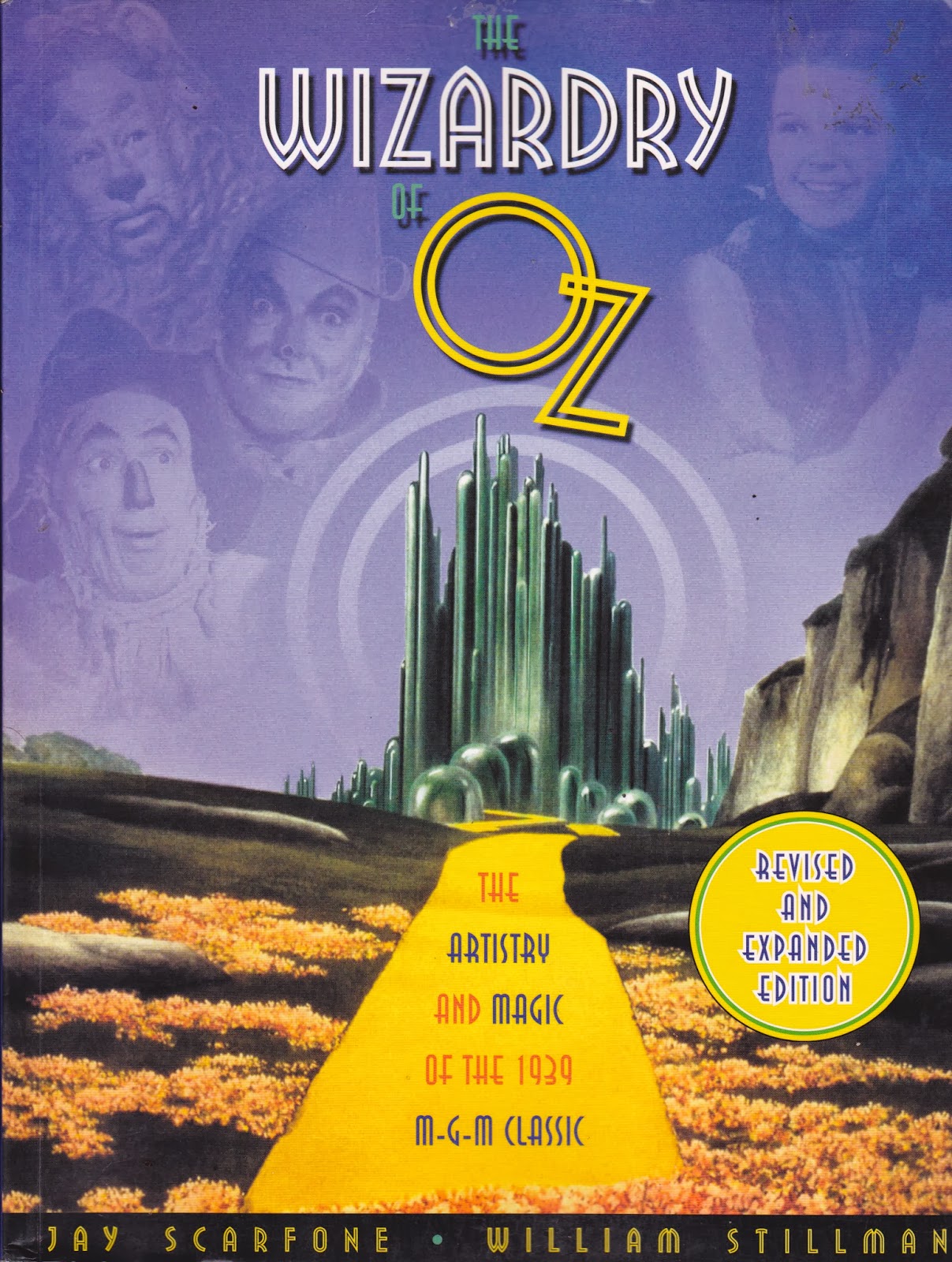
The Wizardry of Oz, by Jay Scarfone and William Stillman, was assembled to highlight the creation of the sets, props, costumes and makeup of MGM's The Wizard of Oz.

Like fantasy epics of today (The Lord of the Rings and The Hobbit, Harry Potter), most of what was seen onscreen in The Wizard of Oz had to be created specifically for that picture. The costumes and set pieces and props to depict the Land of Oz had to be made for the picture: they were depicting another world. Yes, they made it a dream world so they were a little free from adding a level of complete reality to it. But still, the fantastic look of Oz couldn't be found in a store.

The book starts with a look at where the MGM film owes its origins: the original book The Wonderful Wizard of Oz and other adaptations of it and also Disney's groundbreaking fantasy film Snow White and the Seven Dwarfs. It makes it clear that when MGM set out to make The Wizard of Oz into a movie, they were trying for a new spectacle that audiences had not seen before. Today, these films are such classics in our collective psyche that we forget that what they were doing was breaking new ground. Like Snow White, Oz would draw in audiences with an engaging story, lovely music and songs, and spectacular visuals that had never been seen before.

The book is, of course, highly illustrated with sketches, art, stills, on-set photographs, test photographs, but very rarely actual frames from the film. These are beautifully put together and the book is as much fun to look through as it is to read.

We then move straight into the makeup. Highlighted is Jack Dawn's challenge to take the faces of the stars of The Wizard of Oz and turn them into the Scarecrow, the Tin Woodman, the Cowardly Lion and the Wicked Witch and yet have people be able to recognize them as Ray Bolger, Jack Haley, Bert Lahr and Margaret Hamilton. Although they were less challenging, the detail of the makeup of the citizens of Oz, Frank Morgan, Billie Burke and Judy Garland are not ignored.

Next is the costumes: surprisingly, costume designer Adrian had been drawing Oz character designs since childhood and worked with the vivid fantasy MGM was aiming for in creating costumes not just for the principal cast, but also for the Munchkins, the Winkie Guards and the people of the Emerald City.

Third is set design, how MGM's artists turned soundstages into the fantastic world of Oz and the farm in Kansas. The surprising thing about the film is that if you think about it, you can see how it's a soundstage, but it doesn't matter if you're not. The effect is sold that well.

The fourth and last section on the film's production is about the special effects from matte paintings to creating the cyclone to moving trees and flying monkeys, it's all there.

Next, the book showcases the promotion campaign for MGM's movie. Having spent $2,777,000 on the movie, they wanted to be sure people were excited and would go see it. The book discusses the lavish campaign with many, many images of surviving examples of advertising from covers of magazines to posters to cards found in packages of candy cigarettes. A surprising piece is a newspaper page drawn by artist Michelson. It very quickly brings to mind John R. Neill's Oz artwork, though the designs are clearly of the movie.

The book then talks about the impact the MGM movie had on Hollywood after its release from films that tried to mimic its format by bringing full-color fantasy to life onscreen (Shirley Temple's The Blue Bird and the 1940 production of The Thief of Baghdad) to Oz tributes in cartoons and films to re-use of props and costumes in later MGM movies. An especial favorite photo of mine is Shirley Temple at her desk, typing. Next to her is her bookshelf with all of the Oz novels on it in order, except they are in order with the oldest to the right and the latest (The Giant Horse of Oz) to the left. (Giant Horse and Land are the latest and earliest seen. As the photo is dated 1941, we can assume Shirley actually did keep up on the series, and surely she had a copy of The Wizard of Oz.)

The book was originally released in 1999 for the movie's 60th anniversary. My edition was released in 2004 for the otherwise generally ignored 65th anniversary. (The special edition DVD came out in October 2005.) The new edition is listed as "Revised and Expanded" with a number of new material. I haven't seen the 1999 edition. There is a section that gives a brief biography of Terry, the little dog that played Toto, as well as her filmography. The back cover lists the filmography as a new feature.

The Terry section is preceded by a section of never-before printed photos of filming of the movie by Peter Stackpole. It's followed by a complete credit listing for everyone they could identify who worked on the movie.

Overall, The Wizardry of Oz gives a nice look at the creation of the visuals of one of the most important fantasy films of all time. Definitely recommended.