Showing posts with label William Stillman. Show all posts

Wednesday, November 06, 2013

The Wizard of Oz: The Official 75th Anniversary Companion

And the celebration of the 75th anniversary of MGM's The Wizard of Oz has brought another book from Jay Scarfone and William Stillman. And covering the production of the movie in The Official 50th Anniversary Pictorial History and the production design in The Wizardry of Oz, what's left to cover?

Surprisingly, The Official 75th Anniversary Companion still manages to bring new material to readers. The three books form a rather comprehensive trilogy about the making of the film, and there are still other aspects that Stillman and Scarfone haven't touched on. (Aljean Harmetz's The Making of the Wizard of Oz—yet to be covered on the blog—covered a lot of the studio head's work, and John Fricke's book for the Rhino soundtrack album covered the music. Both of these aspects are not highly covered in the Scarfone/Stillman books.)

The book endeavors to bring a number of previously unseen or rarely seen images from the production of the film. There are several that I haven't seen before, while there are still some pictures that will be familiar to those who have read up on the film.

The book is broken into several segments. First and foremost is Baum, then Samuel Goldwyn's attempts to bring Oz to screen before he sold the property to MGM. Stillman and Scarfone tell of a rarely known friendship between Walt Disney and Mervyn LeRoy. (Including that during the many rewrites of the script, Disney loaned MGM a print of Snow White for them to get a better idea of what kind of a story they were going for.)

Sections cover each of the main cast, then the peculiar peoples of Oz, using rarely seen photos to show some of the development of the character's look. Then a summary of the production of the film, how Thorpe began (including the only color photo of Judy Garland in her blonde "Lolita Gale" wig) and Fleming took over after Cukor did some revisions. What exactly the cast did in between shots is also covered, turning up new material.

Then special effects and the design of the film are covered, including some revisions to what we'd thought we'd known about how they created the cyclone and the Horse of A Different Color. Then, the release of the film and its re-releases, and debut on television and legacy. On each topic, the authors dig up some new information.

In the back of the book, there's a silver-colored envelope containing a number of paper memorabilia, some newly designed, some recreated from 1939 items. There's a bookmark, a lobby card, two posters, a booklet of reduced size lobby cards, the death certificate of the Wicked Witch of the East, certificates from the Wizard for Dorothy's friends, a cardboard frame that shows your choice of several paper photos of the Oz characters, and a large mock newspaper clipping from the fictional Oz Herald. It almost feels like the recent Collector's Box set of the film intentionally left any 1939 replicas out just for this book. (Which, remember, it does have two advertisements for.)

Overall, though, the book doesn't really need the bonus memorabilia. The rare photos and new information in the book are worth the price of the book alone. Well done to Stillman and Scarfone!

Monday, October 14, 2013

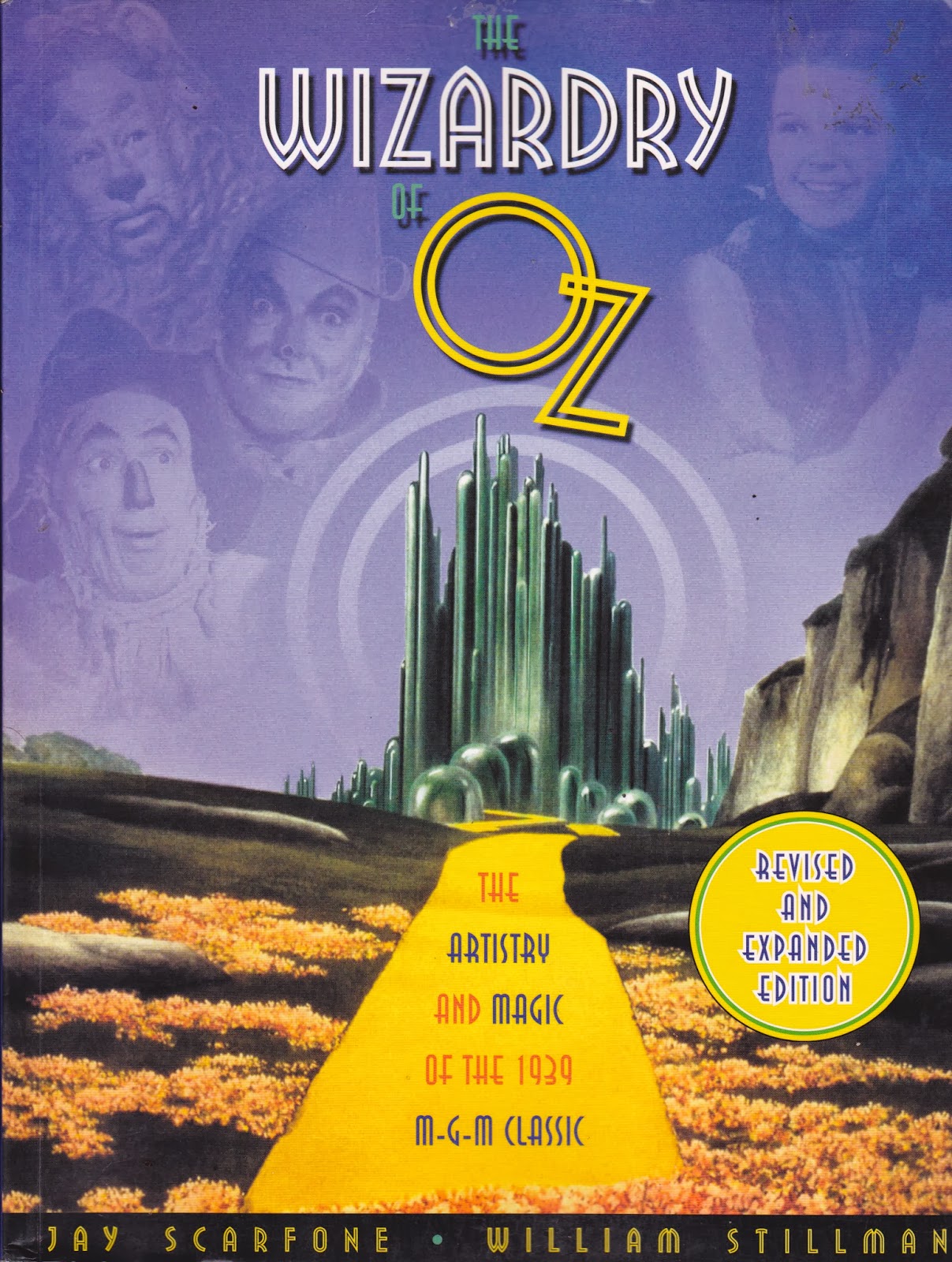
The Wizardry of Oz

The wonderful thing about films is that so much work goes into them from so many angles. Often we focus on the script, the directing, the music and the cast and sometimes forget the massive amount of work it can take to make the film look just right.

The Wizardry of Oz, by Jay Scarfone and William Stillman, was assembled to highlight the creation of the sets, props, costumes and makeup of MGM's The Wizard of Oz.

Like fantasy epics of today (The Lord of the Rings and The Hobbit, Harry Potter), most of what was seen onscreen in The Wizard of Oz had to be created specifically for that picture. The costumes and set pieces and props to depict the Land of Oz had to be made for the picture: they were depicting another world. Yes, they made it a dream world so they were a little free from adding a level of complete reality to it. But still, the fantastic look of Oz couldn't be found in a store.

The book starts with a look at where the MGM film owes its origins: the original book The Wonderful Wizard of Oz and other adaptations of it and also Disney's groundbreaking fantasy film Snow White and the Seven Dwarfs. It makes it clear that when MGM set out to make The Wizard of Oz into a movie, they were trying for a new spectacle that audiences had not seen before. Today, these films are such classics in our collective psyche that we forget that what they were doing was breaking new ground. Like Snow White, Oz would draw in audiences with an engaging story, lovely music and songs, and spectacular visuals that had never been seen before.

The book is, of course, highly illustrated with sketches, art, stills, on-set photographs, test photographs, but very rarely actual frames from the film. These are beautifully put together and the book is as much fun to look through as it is to read.

We then move straight into the makeup. Highlighted is Jack Dawn's challenge to take the faces of the stars of The Wizard of Oz and turn them into the Scarecrow, the Tin Woodman, the Cowardly Lion and the Wicked Witch and yet have people be able to recognize them as Ray Bolger, Jack Haley, Bert Lahr and Margaret Hamilton. Although they were less challenging, the detail of the makeup of the citizens of Oz, Frank Morgan, Billie Burke and Judy Garland are not ignored.

Next is the costumes: surprisingly, costume designer Adrian had been drawing Oz character designs since childhood and worked with the vivid fantasy MGM was aiming for in creating costumes not just for the principal cast, but also for the Munchkins, the Winkie Guards and the people of the Emerald City.

Third is set design, how MGM's artists turned soundstages into the fantastic world of Oz and the farm in Kansas. The surprising thing about the film is that if you think about it, you can see how it's a soundstage, but it doesn't matter if you're not. The effect is sold that well.

The fourth and last section on the film's production is about the special effects from matte paintings to creating the cyclone to moving trees and flying monkeys, it's all there.

Next, the book showcases the promotion campaign for MGM's movie. Having spent $2,777,000 on the movie, they wanted to be sure people were excited and would go see it. The book discusses the lavish campaign with many, many images of surviving examples of advertising from covers of magazines to posters to cards found in packages of candy cigarettes. A surprising piece is a newspaper page drawn by artist Michelson. It very quickly brings to mind John R. Neill's Oz artwork, though the designs are clearly of the movie.

The book then talks about the impact the MGM movie had on Hollywood after its release from films that tried to mimic its format by bringing full-color fantasy to life onscreen (Shirley Temple's The Blue Bird and the 1940 production of The Thief of Baghdad) to Oz tributes in cartoons and films to re-use of props and costumes in later MGM movies. An especial favorite photo of mine is Shirley Temple at her desk, typing. Next to her is her bookshelf with all of the Oz novels on it in order, except they are in order with the oldest to the right and the latest (The Giant Horse of Oz) to the left. (Giant Horse and Land are the latest and earliest seen. As the photo is dated 1941, we can assume Shirley actually did keep up on the series, and surely she had a copy of The Wizard of Oz.)

The book was originally released in 1999 for the movie's 60th anniversary. My edition was released in 2004 for the otherwise generally ignored 65th anniversary. (The special edition DVD came out in October 2005.) The new edition is listed as "Revised and Expanded" with a number of new material. I haven't seen the 1999 edition. There is a section that gives a brief biography of Terry, the little dog that played Toto, as well as her filmography. The back cover lists the filmography as a new feature.

The Terry section is preceded by a section of never-before printed photos of filming of the movie by Peter Stackpole. It's followed by a complete credit listing for everyone they could identify who worked on the movie.

Overall, The Wizardry of Oz gives a nice look at the creation of the visuals of one of the most important fantasy films of all time. Definitely recommended.

Wednesday, October 02, 2013

The Wizard of Oz: The Official 50th Anniversary Pictorial History

I haven't really done a lot of reading up on MGM's classic adaptation of L. Frank Baum's famous Oz book, but this year, I've finally rescinded and picked up a few books about the making of the movie.

This is one of the big ones, and one I think I would have enjoyed as a child due to how heavily illustrated it is.

The Official 50th Anniversary Pictorial History details the origins of The Wizard of Oz story briefly but details the making of the film much more. It actually shows the covers of all of the Famous Forty Oz books and then some (Who's Who in Oz, the Reilly & Lee Visitors from Oz, Yankee in Oz, The Enchanted Island of Oz, The Forbidden Fountain of Oz and Dick Martin's The Ozmapolitan of Oz).

The section on pre-production of the movie proved very fascinating, with the different adaptation concepts nicely detailed. (At one point, none of Dorothy's friends were going to be actually a Scarecrow, Tin Man or Lion, but only people who thought they were brainless and heartless, and a man who'd been transformed into a lion.) Even some pages from abandoned screenplay drafts are included, making me wish some of them would be published in their entirety. Although modern critics sometimes say that the MGM film is nothing like the book, surprisingly, a lot of what it got right was simply stepping back to the source material.

The casting is detailed along with the long, arduous production schedule that went through several directors, a complete scrapping of filmed footage, and the studio almost shutting down the production due to high costs.

Finally, the premiere and re-releases and TV airings are discussed, as well as noting the passing of the principal cast.

Other books have been produced about the making of the film since (Stillman and Scarfone even produced a book dedicated mainly to the design of the production and are coming out with a new book at the end of the month), but this one is an easily readable one if not fully comprehensive. Although out of print, used copies in paperback and hardcover (mine is an ex-library with minimal markings) can be found easily and inexpensively.