Tuesday, March 29, 2011

I am doing terribly!

Sorry for lack of blogs, folks. Fact is, I've gotten in stride into my Oz book, and want to get it finished soon. I told my editor that I expect to have the first draft done by the end of June, but I might finish sooner.

I initially wanted to do a 20-chapter book, noting that Ruth Plumly Thompson usually had that many, but seeing as my story has a tighter plot than Thompson's (that's not ego, it's fact, Thompson could be very loose), I'm looking at about 16.

And the worst thing about writing an Oz story? You come up with ideas for more! So, I have another Oz book in mind. It's not a sequel to this one, in fact, at least one scene takes place before the one I'm working on, explaining an unexplained item in it. And now I will stop being so vague.

Also, I've been contributing some writing for other Oz projects, and what they are, I really can't say right now. But be sure that as soon as I can say, I'll tell you.

And the podcast, yes, I've been working on that. The next episode is being edited right now, though I think I started work on it too late to finish in time for this month, so we might have two next month, really.

Also, the L. Frank Baum birthday special is underway, thanks to the wonderful volunteers. I really love doing those, because collaboration is a lot of fun.

Anyways, back to editing and writing, and I promise, my take on Captain Salt Outside of in Oz will be coming!

Tuesday, March 22, 2011

A Bitty Bit of Information

Cross-posted from my WordPress blog.

In The Wishing Horse of Oz, we meet Bitty Bit, the Seer of Some Summit. I said a little bit (or should that be "a BITTY bit"?) about him here, but I think he deserves a little more attention. Physically, he's a tiny man who resembles a brownie, although I guess he's not quite small enough to be one, as he's apparently about the same size as Dorothy. He has black eyes, and wears a brown robe and a round cap with a quill. All of the furnishings of his castle on Some Summit, a mountaintop in the Land of Ev, are brown or tan. Bitty lives alone in his castle, aside from a chef who is "even smaller than his Master and almost completely enveloped in a great brown linen apron and tall brown cap" (p. 240). I have to wonder if this cook might be a relative of Bitty's. I have long thought that an appropriate (if not particularly creative) name for him would be Bittier.

The seer is particularly good at what he does, telling King Skamperoo, "I know all, I see all, and what is more, I TELL ALL!" I would imagine Bitty is exaggerating his abilities, as he presumably isn't omniscient, but he does seem to be much more clear with his visions than other prognosticators in the series. Characters like Abrog and the unnamed Soothsayer from Purple Prince tend to prophesy in mysterious, equivocal speech; but Bitty is very direct and accurate. Really, I have to wonder why he doesn't get consulted more often, but I guess that might make things too easy. Even in Wishing Horse, as both David L. Greene and Jared Davis indicate, he's basically a deus ex machina. While an interesting character in his own right, he basically just wanders in and solves everything, putting an abrupt halt to Dorothy and Pigasus' quest for allies. The girl and the pig first meet him in his shooting tower, part of his castle that is built of stones with a rubber-like substance in between. It can expand, contract, and coil; and Bitty can use it to venture out into the world and look for things. When he first meets Dorothy and Pigasus, he is looking for sea serpents, but quickly abandons this search to help the two take back Oz for Ozma instead. With his powers, he is able to discover Skamperoo's treachery with no problem, and sends the conqueror away with several wishes that the seer knows will be used wisely. After that, we never see him again. Not in the Famous Forty, anyway. I'm not sure if there are other books that use him, but I did put him in some of my own stories.

Monday, March 21, 2011

The Wishing Horse of Oz

1935, Thompson's fifteenth Oz novel, exactly one more than L. Frank Baum had written, not counting short stories, picture books, or anything in the expanded universe. Twenty-nine Oz books (or twenty-eight, since Reilly & Lee didn't count The Wonderful Wizard of Oz, since they didn't publish it), two authors. Thompson felt her well of ideas for Oz stories was running dry, and she felt Reilly & Lee weren't doing enough to promote the Oz series. This led her to suggest that this Oz book should be the final one.

The Wishing Horse of Oz opens in the kingdom of Skampavia, across the Deadly Desert. King Skamperoo obtains some magic emerald necklaces that grant him the wish for a horse, who happens to talk and is named Chalk. He says he's from Oz, and Skamperoo decides he'll take over Oz.

In Oz, however, a grand celebration is getting underway to celebrate Dorothy and the Wizard "discovering" Oz, with virtually every character from the previous twenty-eight Oz books attending. At the banquet, the Soldier with the Green Whiskers' beard suddenly turns red. Some fear it may be a forewarning of danger. Dorothy swallows a wishing pill (the Wizard seems to have an improved recipe) and wishes that regardless of what happens, she will be able to save Oz and Ozma.

The next morning, Dorothy is surprised to find Ozma, the Wizard, Glinda, Jinnicky the Red Jinn, and every other ruler of any part of Oz and magic worker, gone. No one else notices, and a strange king, Skamperoo, is on the throne. The only person who can help Dorothy is Pigasus. Due to his psychic power of making his rider a poet, he too can remember Ozma when Dorothy rides him. Dorothy realizes they will have to look outside of Oz for help.

They head to the Winkie County, because Dorothy thinks of asking Kaliko or the King of Ev for help. They come across the Black Forest, where everything is jet black. Even worse, Dorothy and Pigasus become black as well and are caught by the Black Watch, who work for Gloma the Witch. Gloma was a witch who retreated to these woods when Dorothy killed the Wicked Witches, so Ozma is completely unknown to Gloma. Fearing that Dorothy may be trying to do her in next, Gloma uses magic to try Dorothy and Pigasus, but they manage to survive. Seeing she is bested, Gloma surrenders to Dorothy, but Dorothy assures her she wishes her no harm. Gloma is able to send the two across the Deadly Desert, removes the blacking, and gives Dorothy a box with a magic powder to create a square mile of total blackness.

They visit Kaliko first. He's frustrated at Dorothy's visit, and would prefer that Ozma stay missing. But he offers what aid he can spare. He discovers Ozma and the missing people on the top of Thunder Mountain, a place where no one has returned safely or escaped from. He also tells Dorothy that he'll send his army if she can enlist another to help conquer Skamperoo. He also gives Dorothy a box of stumbling blocks.

So, wait, Dorothy and Pigasus are on a mighty errand, and are armed with magic weapons, and have a promise for help? This sounds like it could really be Thompson's best yet!

As Dorothy and Pigasus head to the Nonestic Ocean, they find Bitty Bit, the Seer of Some Summit, who, in his completely elastic tower, sees what happened, and takes them back to Oz, where, using the magic weapons and cleverness, they subdue Skamperoo and Chalk. They restore Ozma and Skamperoo is allowed five wishes when he returns to Skampavia. So, all is right again Oz very quickly...

Back in Skampavia, the wishes are turned over to Pinny Penny, Skamperoo's wise prime minister, who uses them for the good of Skampavia: that Skamperoo may be wise and generous, that Skampavia may become rich and prosperous, that the climate and soil would improve, and then, Chalk makes a wish that the three may never be separated, and they may live long. Chalk is added in the final wish.

To me, The Wishing Horse of Oz felt rushed at the end, forcing Thompson to bring in a deus ex machina in the form of Bitty Bit. Thompson had proved she had a great imagination, so I'm sure she would have delivered a different ending, provided the time to work it out. The original edition features numerous errors, suggesting a quick, sloppy editing job as well. It is also noteworthy that this was the last Oz book by Reilly & Lee to feature color plates.

Certainly, the book is not without redeeming qualities, such as the fascinating character of Gloma, a Good Witch of the West (Eric Shanower's The Blue Witch of Oz identifies her as such). It would be worthwhile to revisit her character. Bitty Bit, the deus ex machina that he is, also seems ripe for further expansion, but sadly, these two never re-surface in the Famous Forty.

So, while The Wishing Horse of Oz may be the most exciting build up to a deus ex machina that I've ever read, it is one of Thompson's better books. I just wish she could have fleshed out the ending.

Now, even though Thompson suggested that this should be her last book, would it be?

Thursday, March 10, 2011

Catching up?

Oh, hi!

Um, yeah... I didn't blog in about a month. I moved, so there was a bit of upheaval in my life, and having a computer break down on me in January and buying a replacement didn't help speed things up.

Right now, most of my Oz books are in a storage unit a few blocks from here. With the help of some friends, I may be just waiting on a few more Oz books to complete the Oz stories by the Famous Forty's authors. (Well, I have Eloise McGraw's Rundelstone of Oz in Oz-Story 6. I should probably get a hardcover... Which, yes, David Maxine, I'm sure is very nice...)

I have Neill's The Wonder City of Oz and The Scalawagons of Oz here, and they're actually first editions, or so the sellers told me. They're both Reilly & Lee editions, and certainly old. I got really good deals on them, though both show some signs of damage. (Wonder City's cover is detached. I'm kind of scared to read it much...)

My computer issues were mainly what delayed the podcast last month. I have two podcasts recorded, but they need to be edited. At the time, they were on my old system drive, which was an old hard drive that required not just any IDE to USB bridge. However, I found one that worked, so I have access to that data at last.

This week, I decided to finally catch up on Oz comics. I'm ashamed to say the only issue of Marvel's Ozma of Oz I bought was the first. Well, actually, I did place an order for #2-4, and it has been billed, so I guess I've bought the rest, I don't just have them in hand yet. I do have Marvel's Oz Primer, though.

Also finally ordered Ozopolis #1 and the first three issues of Royal Historian of Oz. And I just finished scouring Springfield's comics shops for a copy of Fables #101 that Eric Shanower did the artwork for, featuring some Oz characters. (No, I haven't been following with the Oz references in that series. I know there's a lot, but it's a bit much to try to catch up on.) No joy, but one comics shop owner said he'd try to help me out. And if that doesn't work out, then there is eBay...

Still puttering at that Oz novel. I'm on a slow chapter, mainly designed to fill time so two parties will meet up at the right place at the right time. I think I'm almost done with it, and once it's done... We're building to the climax!

That's also not the only Oz writing I've done, but since certain things aren't set in stone yet, I'm not saying much more. When and if it happens, I'll let you know.

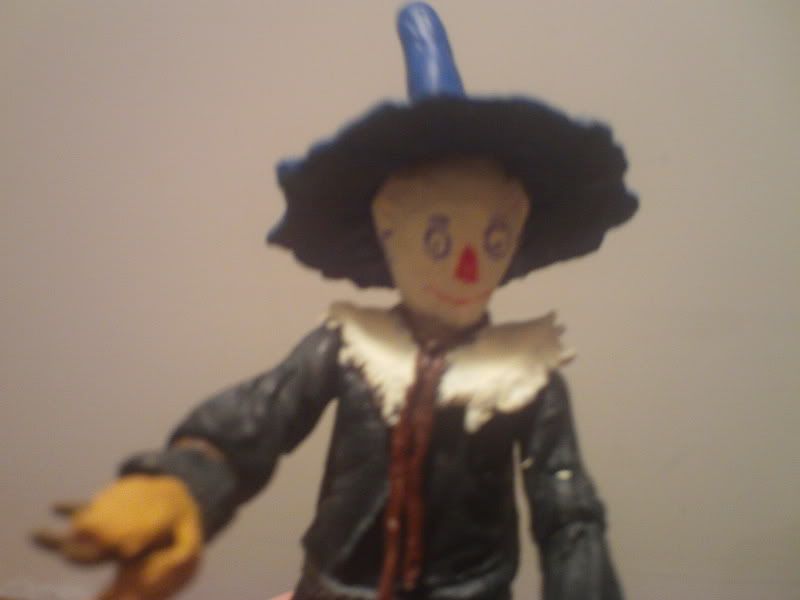
Oh, and yesterday, in less than two hours, I made this guy:
You can read how I made him and how to try your own here.

And one last thing: I'm starting to get L. Frank Baum's birthday podcast ready. We're recording "Tiktok and the Nome King" from Little Wizard Stories of Oz. If you want to volunteer for a character voice, just send an e-mail to scarecrowandtinman2002@yahoo.com

That it? ... I'll just say that even though my Oz books are in storage, I do have a work-around so that the blogs about the Famous Forty can continue. Thank goodness I hit Thompson's public domain books!

Sunday, February 27, 2011

The Royal Podcast of Oz: L. Frank Baum's The Wonderful Wizard of Oz

In this episode, Jared Davis interviews Clayton Spinney and Sean Gates, the director and writer of L. Frank Baum's The Wonderful Wizard of Oz, an independent production set for completion in 2012. As always, you can listen and download at the podcast site, or use the player below.
Download this episode (right click and save)

(And yes, Jared plans to blog again soon!)

Saturday, February 19, 2011

Depicting Oz: Dorothy Gale of Kansas

I spoke before my thoughts on how I feel Oz is best depicted and how often it shouldn't be depicted. For this post, I'd like to express some more on Dorothy, again referencing past and certain portrayals.

(* Any mistakes or errors please let me know so I may fix mistakes to proper formatting *)

When "The Wonderful Wizard of Oz" was published, it was 1899-1900, the Turn of the Century, the new 20th Century and still the time of Pioneers.

Electricity had to be fully realized and mainstream, so the families at that time would use oil lamps with lit candles, and rely more on resourcefulness, neighbourly help and elbow grease.

When I imagine Dorothy, I don't see her as a very pretty girl. Not to say that she is ugly, but just normal looking and, as Princess Langwidere says in 'Ozma of Oz' "Not at all beautiful . . . but a certain style of prettiness". Add that she is an American farmgirl, I prefer not to and don't see her with blonde hair. Nothing to do with Judy Garland but more with Baum and perception, a Dorothy with brown hair looks more normal and properly akin to a farm's setting than a blonde Dorothy - in turn I usually imagine Ozma to have blonde or a more beautiful coloured hair. Dorothy has been well known to be illustrated with a blonde bob by John R. Neill, Eric Shanower and the other artists who have done the Famous 40 and other Oz books. However I feel like this makes her too similar to other girls and less of her own person.

Dorothy having brown hair and visiting a magic land like Oz, Ev etc. stands out more in contrast than a blonde Dorothy coming from a happier Kansas and visiting the magic land of Oz. In film she has been given blonde hair in the 1976 Australian M15+ "Rock 'N' Roll Road Movie", the 1982 Toho anime, 1987 direct-to-video "Dorothy Meets Ozma of Oz" (faithful) half-hour short and a Funky Fables anime. To a lesser extent, you could also include Disney's "Rainbow Road" excerpt played by Darlene, and the 1994 Russian live-action alteration film.
Notable illustrations with blonde Dorothy are Charles Santore and Yutaka Ono for the Japanese books. And there Yutaka gives Dorothy some starry eyes, rosy cheeks, flowery head band, and some near-fancy clothing. He has illustrated the first 3 Oz books several times and has drawn the characters differently, but each time Dorothy is a pretty girl (also the Good Witch of the North is young+pretty and the west Witch is green-skinned). Yutaka doesn't ALWAYS do Dorothy blonde, but they do have a philosophy that girls with blonde hair and blue eyes signifies innocence, though of course this is not always so true in real life or other media.
I believe that Dorothy looks better suited to brown hair and wearing simple farming gowns when experiencing her visit in Oz and is more appropriate that way, than with blonde (short) hair with pretty dresses and "Mary-Jane" shoes with straps which can make her seem less distinct from and bear a greater resemblance to Alice who dreams of Wonderland/Looking Glass, who was first illustrated with blonde hair (although the real life Alice Liddel had a black bob - as the real Dorothy was a five month old baby, little is known about the actual hair).

Another matter concerning Dorothy, moreso than her hair colour or length, is her dressing colour: Baum of course writes her wearing a blue-and-white check gingham gown, "somewhat faded with many washes" and a pink bonnet (plus a basket of food). Yutaka Ono has often drawn Dorothy outside of blue and without her other bearings. My favourite colour is blue so I am a little perplexed when someone avoids this description in the original text, but worst of all the neglecting of a bonnet - protection from the sun - and the basket - food for sustenance along the long journey. It is up to the individual artist to draw Dorothy how they like, but I wonder why at times they take her out of the blue and give her something else like red, pink or some different colour.

- Please don't take this to think that I don't like blondes or pink, I don't mind Dorothy being shown as a blonde when she's done so well by Eric Shanower or John R Neill; I just get tired of seeing it so often and have seen more dark-haired versions -

Baum mentions that Uncle Henry has a long (gray) beard, rough boots, looks stern and solemn, rarely speaks and "worked hard from morning till night", while Aunt Em has lost the sparkles from her eyes and red from her cheeks & lips, is thin and gaunt and doesn't smile. Several adaptations leave out Henry's beard (sometimes completely shaved or with just a moustache & balding hair), but more to the point tend to make Aunt Em fat.
Their age is never specified or hinted at in the text, but the few images of them suggest they could be in their late 40s, early-mid 50s and even late 50s/early-60s. At times however, they are depicted on screen as being old enough to be grandparents, another depiction I don't agree with. Yes it's true that exceedingly hard work and weight can make one appear older than they actually are, but not necessarily DECADES older.

When you consider the time of the story's setting and that the family is poor, it's easier to understand with Baum's description than the chubby-grand portrayals. They are so poor that their beds are out in the open, in the ONE ROOM which also has the dining table + chairs, the cyclone cellar and "a rusty looking cooking stove", all within just these four walls of the house, a house whose paint has peeled away and gets built from wood "carried by wagon many miles". They have no electricity (or even shaving foam) so Henry can't trim his beard as well even if he could, nor should Em fatten up with so little food and neither can Dorothy afford to have dolls or pretty dressings. Some adaptations don't show the family as poor, which is why those tellings give the house some more windows or rooms and even a second floor, but this again could be avoiding the original text description.
The weather is constantly sunny and hot but also cloudy, so the crops don't always get the proper treatment. Crops that are below expectation for sale receive little money, and little money limits the supplies farming families can get. When money is limited, you need to spend what little you have on the more important things like food or house/farm things, and cannot get treats like fancy dresses or toys.

Although Toto is the one black animal that stands out against the grey surroundings, it is this dog that keeps Dorothy happy and appropriately in playful character for her age, preventing the harsh realities of life affecting her prematurely. And an energetic dog with a playful attitude is better than a toy which can get broken and may sometimes be rendered useless, even if it is another mouth to feed.

I know little of farms and what they had or did in that time of life, but I am sure that a trap door in the middle of the house as a cyclone-cellar is safer and closer, even easier, to access during a hurricane or windy storm than one outside the house, as seen in MGM (or even Disney's "Return to Oz").

When Kansas is dreary, Aunt Em and Uncle Henry are worn and grey, and Dorothy has brown hair with simple gowns, then the visit to the fairyland of Oz has a greater and much clearer contrast and shows for a much better telling of the story.

Tuesday, February 15, 2011

Hearts and Minds

Since Valentine's Day just recently ended, I suppose it would be appropriate to talk about hearts. And since this is an Oz post, I'm sure the first subject to come to anyone's mind would be the Tin Woodman, who sought one for his tin body from the Wizard of Oz. The Wizard had no magical powers at this point, but he still provided Nick Chopper with a plush heart stuffed with sawdust, and his friend the Scarecrow with brains made of bran mixed with pins and needles. The story makes it clear that the Tin Woodman and the Scarecrow, respectively, were already kind-hearted and intelligent, but they needed the symbols to be satisfied. In Tin Woodman, Nick explains that his heart is kind rather than loving as an excuse for not having sought out Nimmie Amee, the girl he had planned to marry before his series of axidents. Really, though, I think it's just that, what with his new life and new friends, he really no longer had any interest in Nimmie Amee. He is certainly capable of showing love, even if he claims he isn't.

Some of the later Oz books also play with the idea of hearts and brains. Jack Pumpkinhead uses the seeds in his pumpkins for brains, and while he's hardly the brightest man in Oz, he has occasional flashes of insight. Dr. Pipt gave the Glass Cat brains of shiny pink stones that made her conceited, and a ruby heart that wasn't very compassionate. The Wizard temporarily made her more humble by giving her transparent brains at the end of Patchwork Girl, but she has the pink ones back again in Magic. By the time he brings the Patchwork Girl to life, Pipt seems to have improved on his brain-making abilities, with a set of powders that each provide a particular trait used for her brains. In Tik-Tok, the Great Jinjin Tititi-Hoochoo is said to have no heart, so that emotion and compassion will not interfere with his justice. Moving on to Ruth Plumly Thompson's books, the reanimated Terrybubble seems to function just fine without physical brains or a heart, but he does prefer to keep Speedy in his chest where his heart once was. When dealing with such matters, it's not entirely clear whether the presence or absence of hearts and brains really impact these characters, or they just think they do. In the end, though, I guess it amounts to about the same thing.

Monday, January 31, 2011

Before the Umbrella

Cross-posted from Vovatia.

Much of the plot of Speedy in Oz takes place on Umbrella Island, a land that flies through the air under the power of a magical umbrella. We're told that this was not always the case, however. According to Waddy, the wizard who rigged up the umbrella in the first place, they'd only been flying for about seven years by the time of the story. In a country where people "go on for centuries," as stated later in the book (p. 154) by the royal counselor Kachewka, that must seem like no time at all. The flying has been pretty well ingrained in the culture, however, as demonstrated by the mentions of it in the national anthem. So what was the island like before being able to fly, and how did becoming airborne change it?

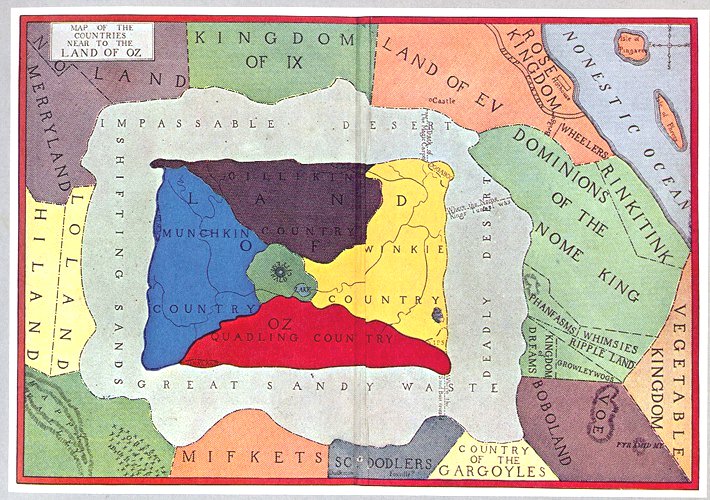
Waddy himself addresses these questions to some extent in his speech to the giant Loxo. The island's original location was "seventy leagues from the mainland of Ev," and close enough to Pingaree from Rinkitink to maintain regular trade with it. We're told at the beginning of Rinkitink that the pearl-rich island only trades with the Kingdom of Rinkitink, but I suppose this could have changed over time. Anyway, if you look at the map from the Tik-Tok endpapers, you'll notice that the Nonestic Ocean is only shown in one small corner, and Ruth Plumly Thompson seems to have initially made an effort to fit all new islands she introduced into that one bit of ocean. She decides to go off the map a bit by the time of Captain Salt, but was apparently still hoping to squeeze everything in when she wrote Speedy.

While still a sealocked nation, the main industry of the island was the raising of silkworms and manufacture of silk fabrics. The suggestion is that the climate was much like that of China, and the people dressed accordingly, in loose blouses and wide silk trousers, with braids in their hair. During the island's flights, however, Waddy introduced fauna from other lands and climes, leading to "rich and tropical" foliage. The wizard also planted the umbrella trees found all over the island, which makes me wonder whether it was even called Umbrella Island prior to the flight upgrade. For what it's worth, umbrella trees are also mentioned as growing in the blue forest in Ojo (see p. 147/ch. 8), and David Perry picks a parasol for his grandmother from one in the Winkie Country in Enchanted Island. Even if umbrella trees were only a recent introduction to Umbrella Island, however, a silk-producing country might still have been known for its parasols. Did Waddy use an umbrella as a means of locomotion because umbrellas were already popular on the island, or did the culture change to reflect the wizard's invention? Thompson and her characters never really tell us.

As for fauna, the pun-filled nature of the Ozian universe makes it pretty much necessary that Umbrella Island would have umbrella birds, which are actually native to Central and South America, but a Nonestic umbrella bird isn't necessarily the same as a mundane one. We're also told that the island is home to forty-six cows, thirty-seven sheep, twenty-two horses, a herd of goats, and a talking cat. John R. Neill's picture on p. 35 also shows a pig, a goose, a chicken, a squirrel, a frog, a dog, and a mouse. How many of these species are native to the country and how many were introduced from other lands is something else we don't really know. In the course of the story, Umbrella Island also acquires an animated dinosaur skeleton, but he's actually American (or, from his own perspective, Virtulan).

A Terrybubble State of Affairs

Cross-posted from my LiveJournal.

One character I see cropping up from time to time on lists of favorites is literally a living fossil. Terrybubble is, in fact, a fossilized dinosaur skeleton, with the bones fused together and animated by a geyser in Yellowstone National Park. He ended up on Umbrella Island in the company of Speedy, a scientist's nephew from Long Island who had been to Oz once before, in The Yellow Knight of Oz. He tries to be a pet for Speedy, and is basically a huge skeletal creature that acts like a dog. (Hey, maybe he's sort of the prototype for Dino from The Flintstones, although Terrybubble can talk.) His odd name comes from Speedy's attempt to say "terrible" after being shot into the air by the geyser.

It's not entirely clear what kind of dinosaur Terrybubble is supposed to be, and it's likely that Thompson didn't have any particular type in mind. He walks on his hind legs, but also has a long neck and fairly long arms. One actual species is mentioned in the text, however, and that's a megalosaurus, which ended Terrybubble's first life. The dinosaur says that their name for the predatory species was "mogerith" (or "mogger" for short), and that his home was the Valley of Virtula, perhaps located in or near modern Yellowstone. By his own admission, he was 400 years old when he died. One of his favorite activities is dythrambing, which involves bouncing around and spinning on his tail. I've heard that some scientists believe large dinosaurs weren't as slow and cumbersome as their size suggests, so perhaps Thompson was ahead of her time in making her own dinosaur creation so acrobatic.

It's interesting that, while dinosaurs have been considered cool by children for some time (I was certainly of that opinion in my own youth), Speedy initially comes across as quite bored at the prospect of seeing dinosaur bones. The book was published in 1934, and I suppose by this point dinosaurs were well enough known that Thompson could expect child readers to recognize one, but perhaps not as popular as they later would be.

Sunday, January 30, 2011

Mr. Mooj Rising

To continue with my old posts on characters from Ojo, here's Mooj, a magician and a clockmaker, who was known to turn people into clocks. I'm cross-posting this from here.

The King of Seebania describes Mooj as a wise man from the north, who worked his way into the good graces of his (the king's) father. Eventually, the magician instituted a coup d'etat, somehow doing away with the old king and locking up his brother and daughter-in-law in a dungeon. As for the heir to the throne, Ree Alla Bad, Mooj made him promise to stay away from Seebania, and just for good measure went ahead and pushed him off a cliff. His wife Isomere turned out to already be pregnant, however, and the old king's brother Stephen managed to bribe the guards and escape with the baby. And that baby was Dorothy, whom Stephen somehow managed to smuggle to Kansas. Just kidding. The baby was actually Ojo, and as Prince Stephen became afraid to talk unless absolutely necessary, he came to be known as Unc Nunkie, the Silent One. And now you know the rest of the story. Not all of it, though, because the plot of Ojo is set in motion when Mooj finds out about the boy, and sends a message to the criminal community of Oz saying that anyone bringing Ojo to him would receive a reward of 5000 bags of sapphires. He does manage to get his hands on the boy, but Ozma and the Wizard of Oz arrive to save him. Ozma then proceeds to turn the crafty clockmaker into a drop of water in the Nonestic Ocean, deeming him too dangerous to leave in a conscious form.

While Mooj is said to have gained the support of the Seebanian populace by way of magic, and he's seen in a crown and velvet mantle when Ozma and her companions confront him in Shamsbad, it doesn't appear that he does a whole lot to take advantage of his position as king. Instead, he spends most of his time in his hut on a lonely mountain peak, tending to his clock-making. This led to some suggestion during the discussion of Ojo on the Nonestica mailing list that his goal wasn't gaining possession of the throne so much as neutralizing Seebania as a regional power.

What makes Mooj particularly memorable is how Neill chose to draw him. Thompson describes him as "a bent and evil-looking old Munchkin," and says that he looks "ridiculous" in royal regalia. Neill, however, chose to depict his face as showing signs of his chosen profession, resulting in a truly creepy individual.